Automation in the BPO industry: what it is and how to use it
Automation in BPO industry decides who keeps the margin. What it takes off your floor, what the numbers say, and why pricing beats software.
How much of a BPO can software actually run? We have spent the last few years deploying AI agents into support operations, and our answer on automation in BPO industry work now fits in one paragraph:
Automation in the BPO industry means software doing the work agents used to do by hand: answering routine calls and messages, moving data between systems, checking quality. Done well, it resolves half or more of routine conversations without a person and cuts the cost per contact, while your team keeps the difficult cases.
The interesting question is not whether that works anymore. It is who keeps the money when it does. Most of what gets written on this topic dodges that question, so this is our attempt to answer it properly.
What is automation in BPO industry operations?
Two families of work, and only one of them is news.
The first is paperwork: reading documents, copying data between systems, filing outcomes. Software robots (the industry calls this RPA, robotic process automation) have done this for years, and most large operations already run them.
The second family is conversations, and this is the shift we bet our own business on. AI agents now read or hear a customer’s actual request, answer it from the client’s own information, and finish the job: book the appointment, process the refund, update the record. The caller who mixes three questions in one message, the one who broke every chatbot of the last decade, gets a real answer. The industry still files this under call center automation, but the channels outgrew the phone years ago: we run it on thirteen channels, from calls to WhatsApp.
Our rule of thumb, and the only definition you need to keep: if an interaction repeats, software can take it. If it needs a judgment call, a person keeps it.
What does it replace, and what stays human?
Picture an agent, call her Lena, on her 40th call of the day. “Where is my order?” She asks for the number, reads a tracking page out loud, says have a nice day. Forty-five seconds where her brain was needed for none of it. Her 41st call is a customer three weeks past the refund window, furious, mentioning a lawyer. That one needs everything she has.
Automation exists to take call 40 so Lena is fresh for call 41. On paper, the split looks like this:
| The work | Who takes it |
|---|---|
| Order status, opening hours, account lookups | Software. These should never reach a seat |
| Booking and moving appointments | Software, writing straight into the diary |
| Reading and filing documents, claims, invoices | Software, with a person checking the exceptions |
| Refunds inside the written policy | Software. Outside the policy, a person decides |
| Complaints, distress, legal threats | Always a person, brought in fast with the full history |
The last row is the one we defend hardest in every deployment. Escalation is not failure. On a regulated programme, escalation is the product.
What do the numbers say?
Three results we trust, because two are published by firms with reputations to lose and one is ours:
- Bain rebuilt a large BPO’s cost structure around automation; the operator is on track to beat its own cost-reduction targets by 50%, with fewer errors as the bonus.
- IBM notes that companies often outsource to save as little as 30%. Automation is what we have seen push past that, in its write-up an insurance deployment saved $1 million in its first year while raising productivity 5%.
- On an account we run for an aesthetic clinic, 54% of 2,011 conversations over eight months ended on a booking with no human involved, and every message got its first answer within a minute.
The clinic taught us something we did not go looking for. 813 of its 2,011 conversations, 40%, arrived outside opening hours, 221 of them on Sundays with the doors shut (the full numbers are in the case study). Demand does not keep your schedule, and we now believe most BPOs do not lose money on cost; they lose it on missed coverage. The hours you do not staff are a product: automated night and weekend coverage you can sell to every client tomorrow, delivered by software with your people on call for the flagged cases. We wrote up what a 24/7 answering service actually requires if you want to build that offer properly.
What does it do to your invoice?
This is where we stop being neutral, because the pricing model decides everything and almost nobody writes about it.
On the programmes we see, 50 to 60% of contacts repeat; on the clinic account it was 54%. Say a programme handles 10,000 conversations a month. Staffed the classic way, that is about 1,250 agent-hours; at €28 an hour, a €35,000 invoice, €3.50 per conversation. Automate the repeating share and your cost per conversation drops under €1.60. Two ways to bill it:
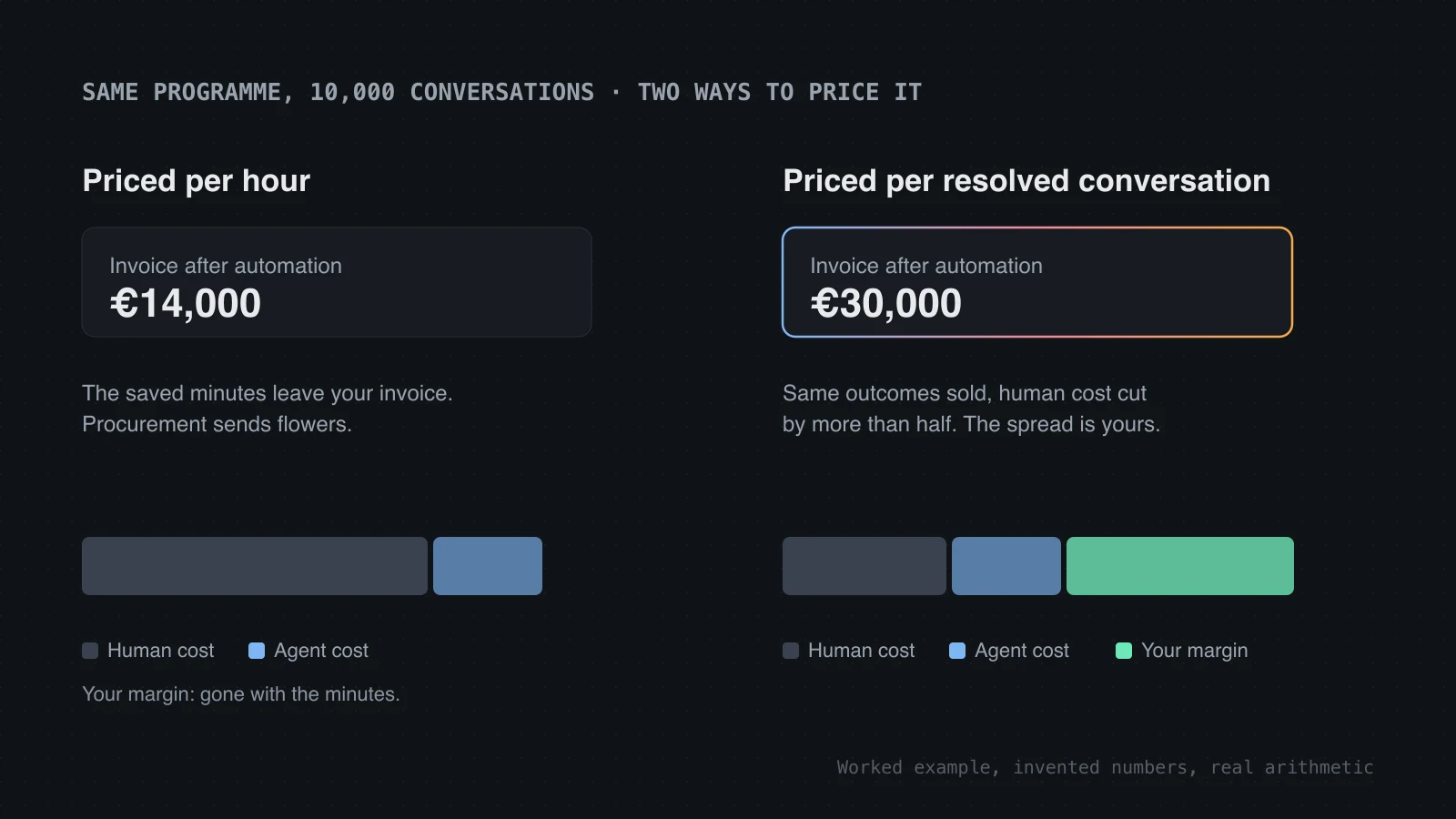
Bill by the hour and the saving belongs to your client: the invoice falls to €14,000 and your margin leaves with the minutes. Bill by the resolved conversation, at €3 each, and the invoice is €30,000 while your costs are cut by more than half. The difference is yours. Same software, opposite outcome. (Worked example, invented numbers, arithmetic you should rerun on your own volume.)
RUN IT ON YOUR OWN FLOOR
What automation does to your cost per conversation
Assumes 7.5 minutes per conversation and software at €0.12 per automated one, the same shape as the worked example above. Your numbers will differ: that is the point of the sliders.
Every BPO owner we have had this conversation with reacts the same way: the technology was never the frightening part. Repricing twenty client contracts is. But that is the work. The operators who win this decade sell the handled conversation, the booked appointment, the resolved ticket, and let software shrink what it costs to deliver one.
Where does the customer data go?
The question your EU clients will ask before any of the above, and the section missing from every guide we benchmarked.
When an AI agent answers your client’s customers, their names, messages, medical questions and payment disputes flow through whatever stack you picked. That makes your automation vendor a data processor in the GDPR sense, and it makes four questions non-negotiable before a pilot, not after:
- Where is it hosted? For European programmes, EU hosting is not a preference, it is the shortest path through your client’s security review. (Ours runs in Europe; we sell to European businesses, so we never had a choice to get this wrong.)
- Who is the model provider, and what do they retain? Your client deserves a named answer, not “a leading LLM”. For large accounts, bring-your-own-key arrangements put the model contract, and therefore the data terms, in the client’s own hands.
- What gets deleted, and when? Conversation logs are personal data. A retention schedule you can show beats a policy page you can point at.
- Can you produce the audit trail? Who escalated what, when, and what the software was allowed to say at the time. Regulators ask BPOs this today; with the EU AI Act phasing in, the questions get more specific, not fewer.
None of this is a reason to wait. It is a reason to make data protection a selling point: the BPO that walks into a review with hosting, retention and audit answers written down wins the deal against the one that says “our vendor handles that”.
What goes wrong?
Four things. We have watched all four happen.
Invented answers. An AI that improvises on a client’s programme is how you lose the client. The fix is written rules: what the software may say, may do, and must hand to a person, fixed in advance and shown to the client. One of ours went from “creative but wrong” to “boring but correct” after feedback, and we have never been prouder of something so uncreative. Boring but correct renews contracts. Those written rules are, in practice, a chatbot script built out of nodes and intents instead of a free-running prompt.
Your quality metrics shift. When software absorbs the 45-second lookups, your people keep only the hard conversations, so average handling time goes up. Renegotiate any contract that rewards raw handling time before the rollout, not after. Bring it up yourself; it reads as competence. (We go deeper on what this does to QA, agent cost and forecasting specifically in AI in BPO: where does the money actually move?)
The repricing conversation. It sounds like this: “we are moving this programme from hours to resolved conversations; your bill stays close to flat, your night coverage becomes instant, and our SLA moves from answer time to resolution rate.” Some clients take it in one meeting. Some take a quarter. None of them take it well mid-contract, so start with renewals.
Team worry. Agents adopt tools that eat the boring half of the queue and resist tools that watch them. Lead with the first. Where a client is contractually buying headcount, have the commercial conversation before the rollout.
How do you start?
Not with a six-month pilot. Clients have heard “full automation” from every vendor since 2023; in our experience you have a few weeks of their patience, not quarters.
- Sort one day. Take your highest-volume programme and split one day of interactions into the two piles from the table. The repeats pile is your target.
- Run a short live test. A few weeks, real traffic. Software takes the repeats, your team takes the rest.
- Show three numbers. Conversations solved without a person, time to first answer, difficult cases handed over correctly. Value the client feels in their operation, not a demo.
When you compare BPO automation software, four questions expose most of the field: Does it write into your client’s systems, or does it only chat? Do all channels land in one queue your team watches? Are the rules written down and shown, or improvised? Does the pricing follow usage, or does a per-seat licence tax the people you keep? The same four questions apply outside BPO too; see how ten customer support automation tools answer them.
If you would rather have the software side handled while you keep the client and the margin, that is the partnership we run with BPOs. Either way: one day, two piles, this week. The arithmetic will tell you the rest.
FAQ
What is automation in customer service, concretely?
Software answering and acting instead of a person: an agent that picks up the call or the WhatsApp, gives the client's approved answer, books or files the outcome in the client's systems, and hands the conversation to a human when the rules say so. The tell that it is real automation and not a deflection widget: the conversation ends resolved, not redirected.
Which software runs in a BPO today?
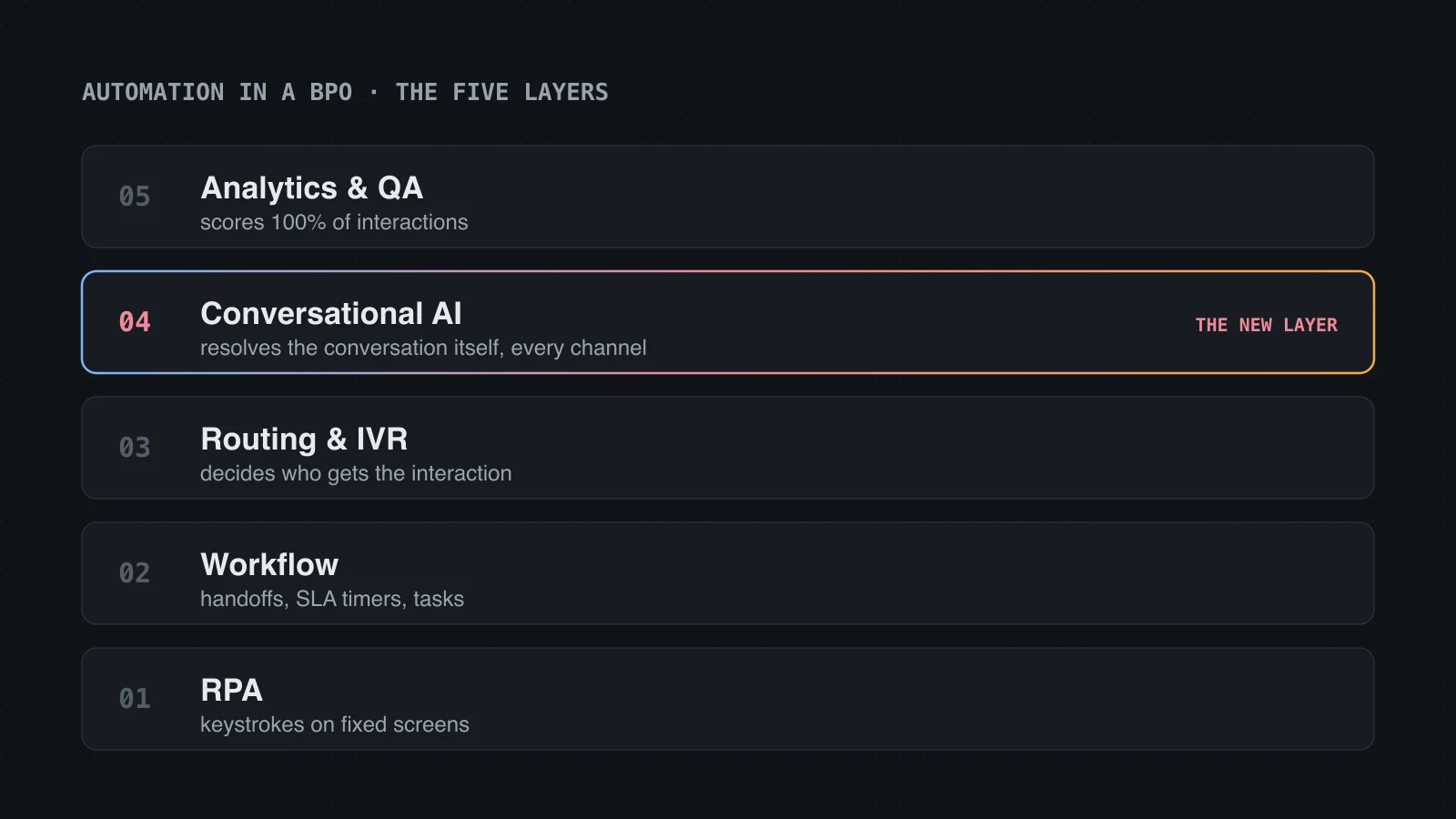
Five layers, usually from different vendors: telephony and routing (the IVR and dialer), the CRM or ticketing system, RPA bots for back-office keystrokes, quality assurance and analytics on recordings, and now conversational AI on the front line. The expensive mistake is buying layer five without deciding how it hands work to layers one to four.
Is AI a type of automation?
It is one layer of it. RPA automates keystrokes on a fixed screen; workflow tools automate handoffs between systems; AI automates the part that used to be unautomatable, understanding what a human wrote or said. A BPO needs all three, and the discipline to keep the AI inside guardrails.
Will automation replace BPO agents?
It replaces the lookup-and-typing part of the job, which on routine programmes is most of the minutes. The agents who remain handle escalations, judgment calls and angry exceptions, which is harder work and worth more per hour. Headcount per programme drops; value per agent rises.
How long should a BPO automation pilot run?
A few weeks on one real programme, with live traffic. Long enough to produce numbers the client cannot argue with, short enough that skepticism has no time to win. If a vendor proposes a six-month proof of concept before anything touches production, that is a science project, not a pilot.