Best Aesthetic Clinic Software in 2026: 6 Platforms Compared
The best aesthetic clinic software in 2026, six platforms with real pricing pages checked, plus the patient-answering layer none of them cover.

You typed “best aesthetic clinic software” because a spreadsheet finally broke, or because the rep on your last demo call couldn’t say the price out loud without three follow-up emails first. Both are common enough that most of what’s written on this topic pulls from the same six or seven names, in the same order, and skips the same question: who answers the patient before any of this software even sees them. We checked what six platforms actually charge (half hide it behind a demo), what they actually do, and the layer none of them touch.
The best aesthetic clinic software in 2026 depends on what’s actually broken. AestheticsPro and Clinicminds publish real monthly prices and run full EMRs. Pabau and PatientNow scale pricing by team size, quoted after a demo. Zenoti fits multi-location groups already buying into its AI add-ons, and MDware customizes everything from a phone call. None of the six answers a patient message at 11pm; that’s a separate layer, covered near the end.
How we checked these six
Every screenshot below was captured from the vendor’s own pricing page in September 2026. Three platforms show a real number. Three show plan names and nothing else, with “book a demo” standing in for a price. We ranked accordingly, roughly by how much of the decision you can make before anyone calls you back, because that’s the one thing every buyer of this software has in common: you’re going to be on a demo call regardless, the question is whether it’s to learn the price or to learn the product.
We also went and read the three existing “best aesthetic clinic software” articles ranking above this one, because that’s who you’d otherwise be comparing us against. All three compare charting, compliance, booking and payments. Not one mentions what happens to the message a prospective patient sends at midnight, which is a strange gap for an industry where, per the clinic account whose numbers appear later in this piece, 40% of contact arrives after the doors are shut.
Every platform we captured a screenshot of got the same treatment: its own pricing page, fetched fresh, read for what it actually states rather than what its sales copy implies. Where a table below says a feature isn’t shown, that’s a statement about the page we reviewed, not a claim that the feature doesn’t exist somewhere behind the demo.
What aesthetic clinic management software actually means
Strip the marketing and this category, aesthetic clinic management software, cosmetic clinic software, whatever a given vendor calls it this quarter, is practice management software with a medical layer bolted on: electronic charting (SOAP notes, before-and-after photos, consent forms), compliance controls (HIPAA in the US, GDPR in Europe, PIPEDA in Canada), online booking, point-of-sale, inventory tracking down to the lot number on a vial of filler, and reporting dashboards. Some platforms add prescribing, telehealth, or AI note-generation on top. All of it assumes a patient who has already decided to book and is now inside your system.
That’s one half of running a clinic. The other half, whoever answers “what does a hair transplant cost” at 11:47pm on a Tuesday, when the person asking is also messaging your two nearest competitors, barely shows up on any of these pricing pages. We’ll come back to that. First, the six.
Compliance is not a checkbox either, on either side of the Atlantic: HIPAA sets the floor for handling patient health data in the US (HHS.gov), and GDPR does the same across the EU (European Commission), and a vendor that only names one of the two is telling you something about which market it was actually built for.
Medspa software, medical spa software, aesthetic clinic software: not always the same search
Three of the terms people use to find this category pull different results, and it’s worth knowing which one you’re actually typing. “Medical spa software” and “medspa software” search several times more often than “aesthetic clinic software” does, and a good chunk of what ranks for them is built for a broader spa and wellness business, waxing, massage, facials, with medical services bolted on as one service line among many. Vagaro is the clearest example: it shows up in more than one “best aesthetic clinic software” roundup, starts at $23.99 a month, and is genuinely built for salons first. Fine if injectables are 10% of your revenue. A liability if they’re the whole business and the platform has no real EMR behind the booking calendar.
“Aesthetic clinic software” and “aesthetic nurse software” skew the other way, toward vendors built around clinical charting, consent, and compliance from day one, which is where all six platforms in this piece sit. If your practice is medical first, injectables, hair restoration, dermatology, surgery, search (and buy) in that second category, not the first, even though the first shows up far more often and with flashier marketing.
The 6 best aesthetic clinic software platforms, at a glance
| # | Platform | Best for | Pricing shown | Starts at |
|---|---|---|---|---|
| 1 | AestheticsPro | Seeing every tier’s real price before you call anyone | Yes, full ladder | $160/mo |
| 2 | Clinicminds | Multi-location, multi-country med spas that want a cloud EMR | Yes, starting price | €160/mo |
| 3 | Pabau | Practices that want pricing that scales cleanly with headcount | Named tiers, no figures | Quote after demo |
| 4 | Zenoti | Multi-location groups also buying into AI ops agents | No | Quote after demo |
| 5 | PatientNow | US clinics bundling EMR with marketing automation | No | Quote after demo |
| 6 | MDware | Practices that want everything scoped to them from call one | No | Quote after demo |
1. AestheticsPro: the only ladder with every rung priced
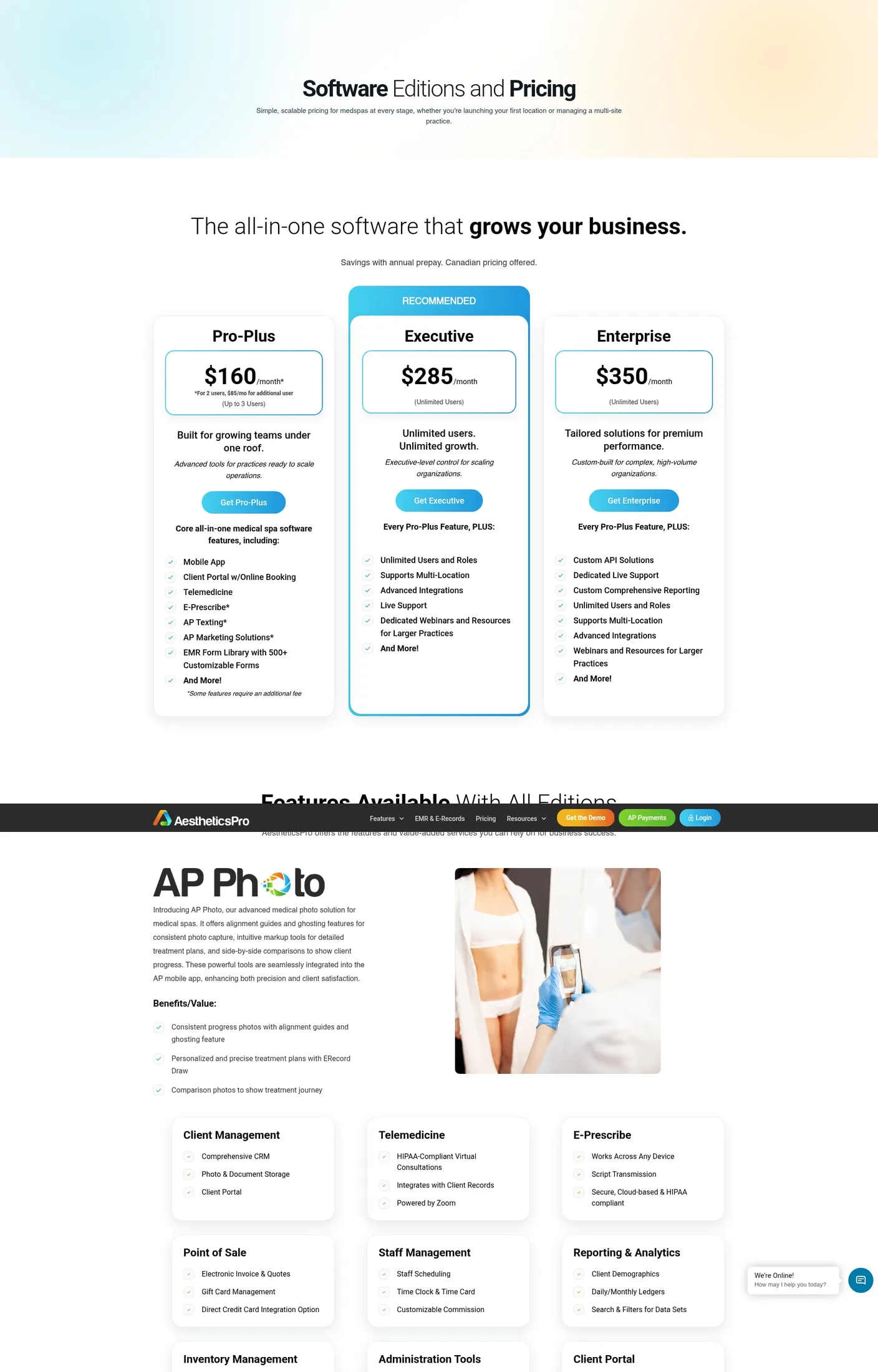
Three tiers, three real numbers: Pro-Plus at $160 a month (two users included, $85 for each additional, capped at three), Executive at $285 for unlimited users, and Enterprise at $350, also unlimited, for “custom-built” high-volume practices. That’s rarer than it should be in this category, and it’s the reason AestheticsPro leads this list rather than a verdict on features nobody else discloses.
What you get for it: a full EMR with a 500-plus-form library, HIPAA-compliant telemedicine running over Zoom, e-prescribing, a client portal with online booking, and AP Photo, its own before-and-after capture tool with alignment guides so progress photos actually line up frame to frame. Multi-location support and advanced integrations only unlock on Executive and above, which is the one place the pricing page’s simplicity costs you: a two-location practice needing centralized reporting is already looking at $285 minimum, not the advertised $160.
2. Clinicminds: fewer dollars up front, more proof behind it
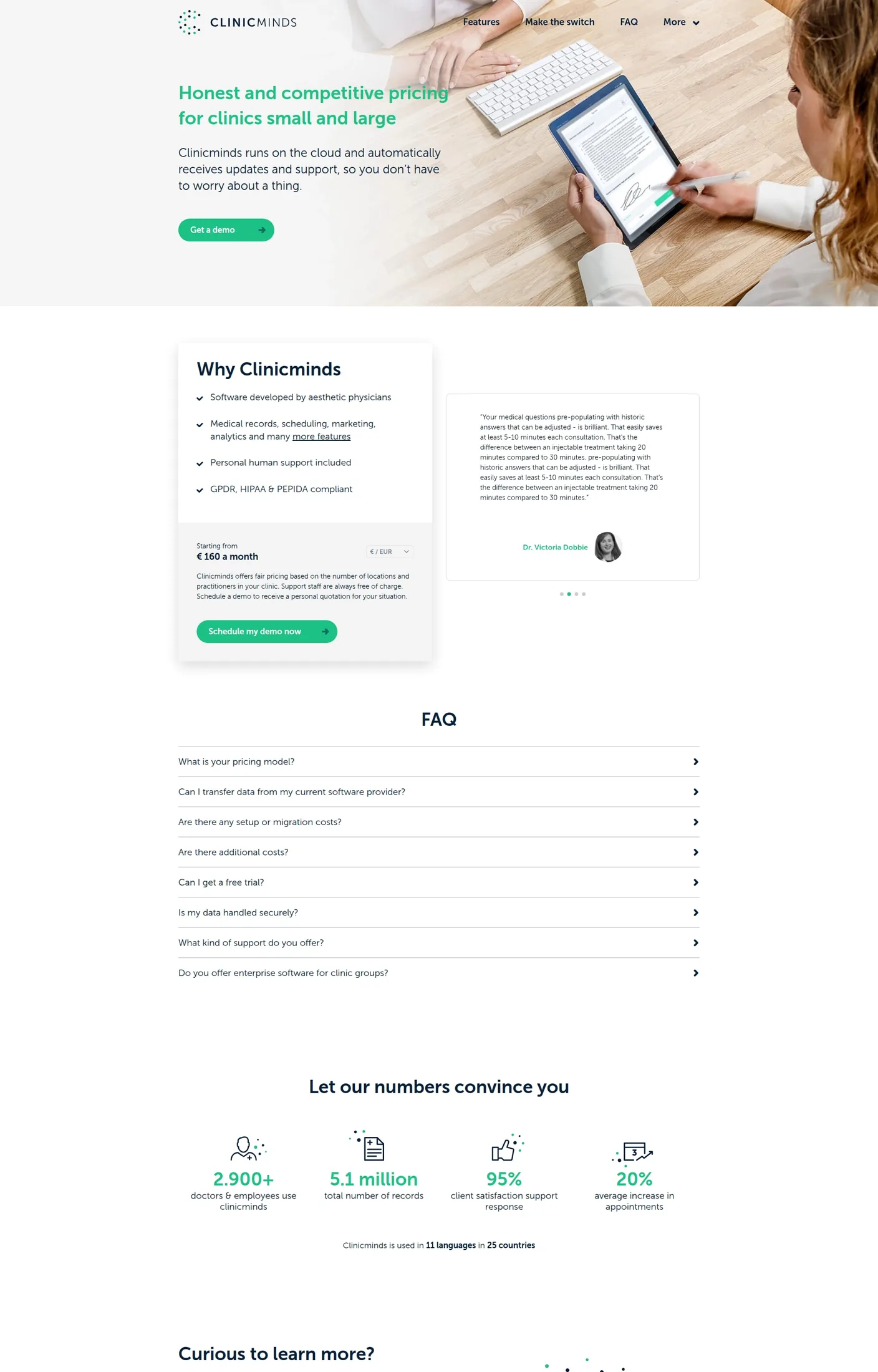
Clinicminds shows a floor, not a ceiling: “starting from €160 a month,” with the actual number depending on locations and practitioners, confirmed on a demo call. What it backs that up with is unusual for a vendor this size: 2,900-plus doctors and staff on the platform, 5.1 million patient records, a claimed 20% average increase in appointments, and reach into 25 countries across 11 languages. It’s built by aesthetic physicians rather than a general practice-management vendor retrofitted for the specialty, which shows in how the workflow is described: medical questions pre-populate from a patient’s history, cutting minutes off every consultation rather than just off the paperwork after it.
Compliance is the other headline: GDPR, HIPAA and Canada’s PIPEDA are named directly on the site, useful if you run locations across more than one of those jurisdictions and don’t want three separate answers about where patient data actually lives. What’s missing from the pricing page itself is anything past the starting figure: a solo practitioner and a five-location group both see “€160” until they book the call.
3. Pabau: priced by headcount, not by feature
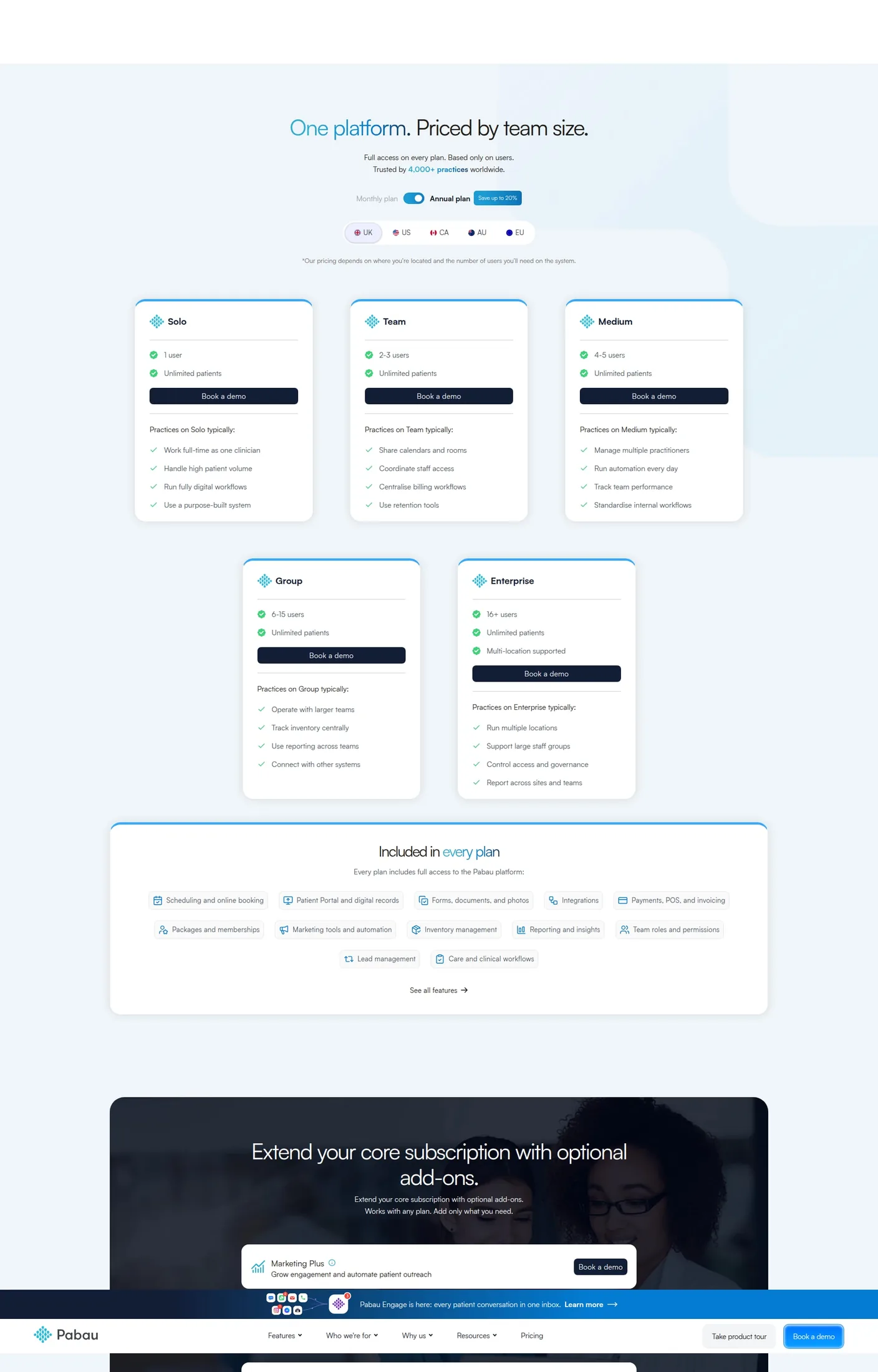
Pabau’s pricing page names six tiers, Solo through Enterprise, sized by user count from one up to sixteen-plus, each with unlimited patients and full platform access regardless of tier. No dollar figure appears anywhere; every tier ends on “book a demo,” and the page is upfront about why: “our pricing depends on where you’re located and the number of users you’ll need on the system,” with separate country tabs for the UK, US, Canada, Australia and the EU. Annual billing saves up to 20%.
Every plan includes scheduling, a patient portal, forms and photo storage, payments, packages and memberships, marketing automation, inventory, and Pabau Scribe, its AI charting-notes tool, so the tiers scale you up in seats and support rather than gating features behind a higher one. One line on the pricing page is worth reading twice if you’re evaluating this specifically for the gap this article is about: a banner reading “Pabau Engage is here: every patient conversation in one inbox.” That’s the closest any of the six get to the answering layer, and it’s worth being precise about what it is: a shared inbox a human still has to open and reply from, not an agent that answers before anyone’s logged in.
4. Zenoti: the one selling AI agents, not just AI features
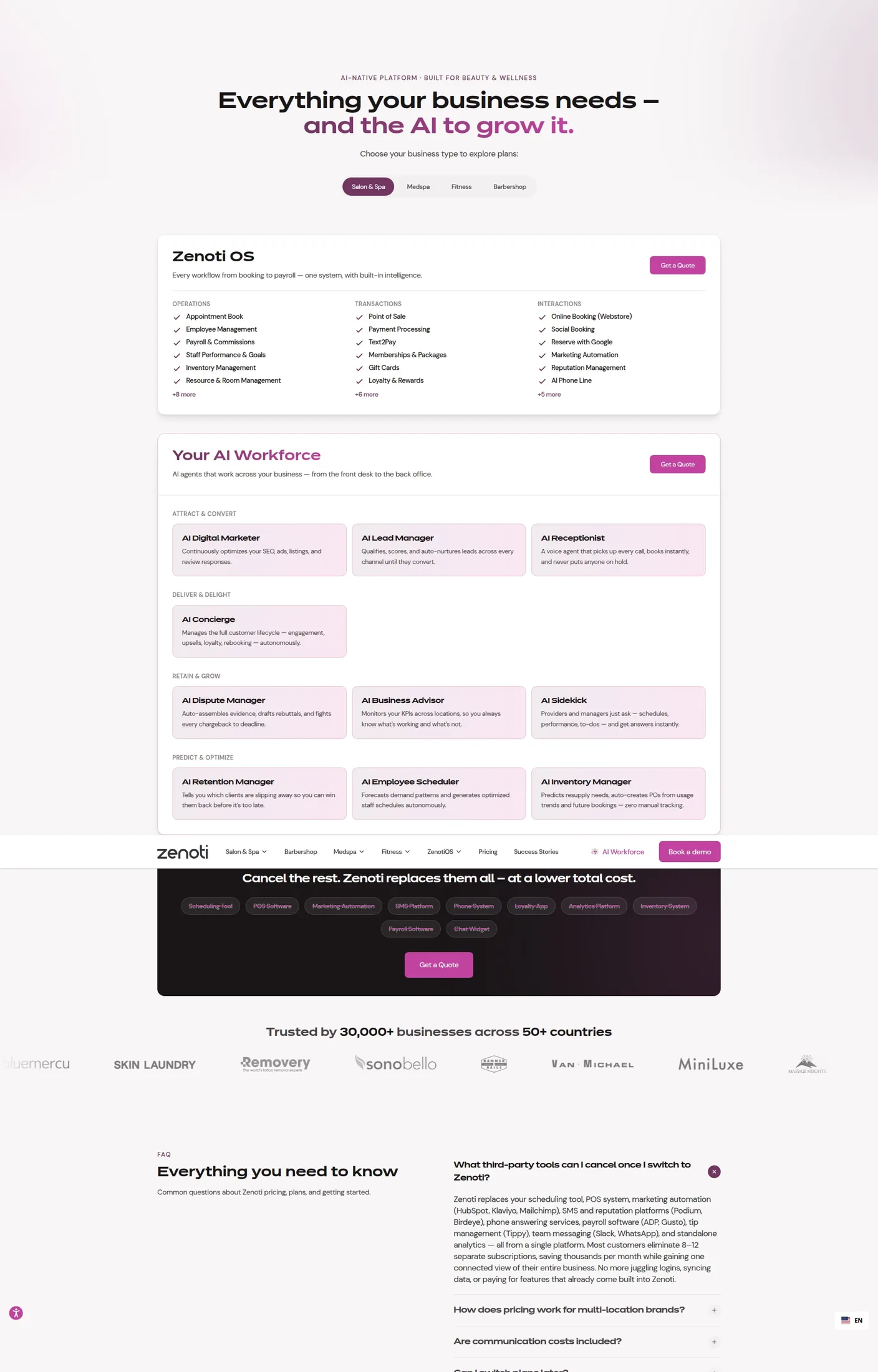
Zenoti’s pricing page shows no number at all, splitting instead into two products: “Zenoti OS,” the core scheduling, POS, payroll and marketing platform, and a separate “AI Workforce” of nine named agents, an AI Digital Marketer, Lead Manager, Concierge, Dispute Manager, Business Advisor, Sidekick, Retention Manager, Employee Scheduler, and Inventory Manager. Both are “Get a Quote” only, and the FAQ says pricing is “customized based on your footprint,” aimed squarely at multi-location groups (the page claims 30,000-plus businesses across 50-plus countries) rather than a single clinic.
One agent on that list matters more to this article than the other eight: an “AI Receptionist,” described on Zenoti’s own page as “a voice agent that picks up every call, books instantly, and never puts anyone on hold.” That’s the only genuine attempt among these six platforms at the layer the next section is about, and it deserves the credit for existing. It’s also, by Zenoti’s own description, phone-only, and priced inside a package you can’t see the cost of without a quote. A patient messaging on Instagram or WhatsApp, which is how most inquiries reach the clinic in the case study below, is outside its scope entirely.
The client logos on Zenoti’s own pricing page (Sono Bello, Skin Laundry, MiniLuxe, Massage Heights among them) skew toward multi-site national brands rather than single-location practices, which lines up with the “30,000-plus businesses across 50-plus countries” claim and confirms who the quote-only pricing is actually built to filter for.
5. PatientNow: the AI branding is in the tier name itself
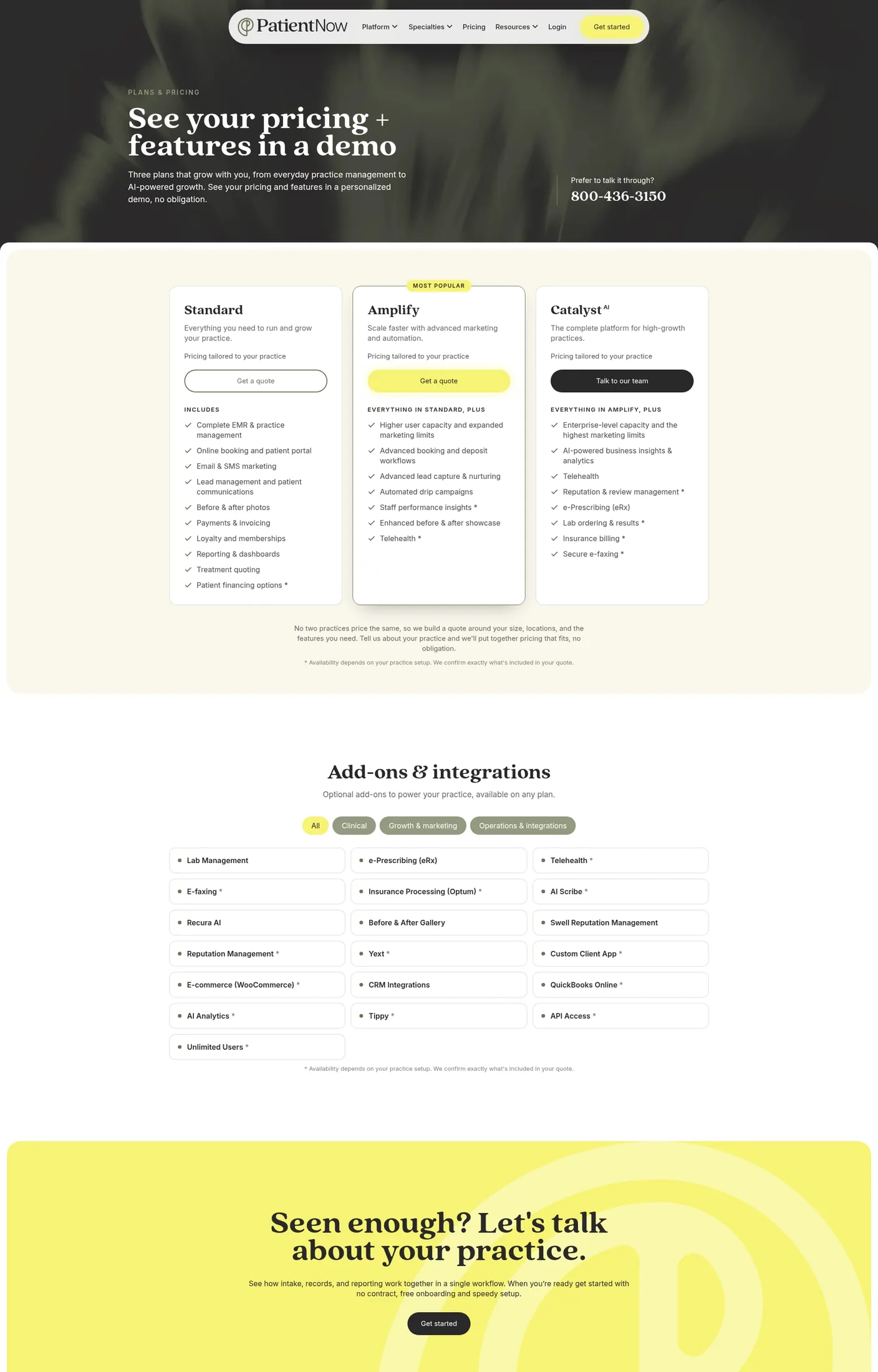
Standard, Amplify, and Catalyst AI: three tiers, each labeled “pricing tailored to your practice,” none showing a number. Standard covers a complete EMR, online booking and patient portal, email and SMS marketing, before-and-after photos, payments, and treatment quoting. Amplify layers on advanced booking and deposit workflows, automated drip campaigns, and telehealth. Catalyst AI, the top tier, adds AI-powered business insights, e-prescribing, insurance billing and secure e-faxing, several marked with an asterisk reading “availability depends on your practice setup,” which is worth asking about directly rather than assuming from the tier name.
Add-ons sold separately include an AI Scribe and something called Recura AI, alongside more conventional integrations (QuickBooks, CRM tools, e-faxing). The pattern across all three tiers: everything is real functionality, and none of it has a price you can see without a conversation, which puts PatientNow in the same bracket as Pabau and Zenoti on transparency even though its feature list reads closer to AestheticsPro’s.
6. MDware: everything custom, one number that isn’t a price
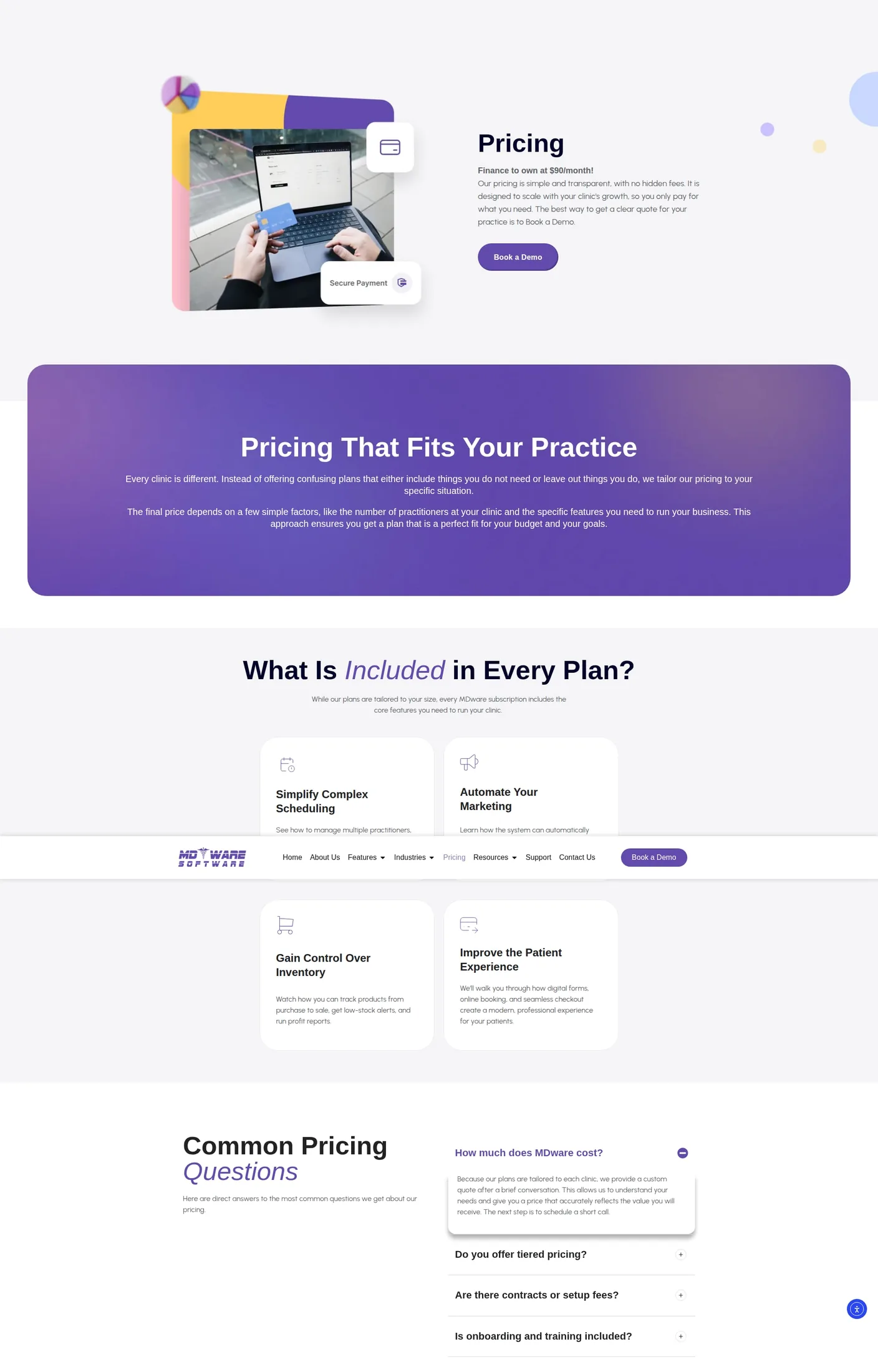
MDware’s pricing page carries exactly one dollar figure: “Finance to own at $90/month!”, sitting above three paragraphs explaining that pricing is otherwise “simple and transparent” and depends on “the number of practitioners at your clinic and the specific features you need,” confirmed on a demo. No tier names, no feature ladder, nothing to compare against the other five without booking that call. The FAQ section directly under it, titled “Common Pricing Questions,” answers “how much does MDware cost” with the same instruction: book a call.
MDware’s own case for itself, made directly under the pricing block in four named pillars, “Simplify Complex Scheduling,” “Automate Your Marketing,” “Gain Control Over Inventory,” and “Improve the Patient Experience,” centres on running the operational side of an established clinic rather than competing on clinical depth. Judged purely on what the pricing page tells a visitor before any contact information changes hands, though, it’s the least transparent of the six.
Why every one of these suddenly has an AI Scribe
Pabau Scribe. PatientNow’s AI Scribe add-on. Zenoti’s AI Business Advisor reading your KPIs across locations. Meevo, outside our six, has Convobar. Every vendor in this category shipped some version of “AI writes your notes” or “AI reads your numbers” in roughly the same eighteen-month window, which is worth naming plainly: this is charting and back-office AI, aimed at the clinician and the owner, not at the patient. It saves a practitioner minutes per consultation dictating notes instead of typing them, and it’s genuinely useful for that.
It is not the same claim as “AI answers your patients,” and only one vendor here, Zenoti, is even attempting that second thing, scoped to phone calls, inside a package with no listed price. Worth keeping the two apart when a sales deck uses “AI-powered” as a single word covering both, because they solve different problems and you’d budget for them differently.
Side by side: what’s actually included
| Platform | EMR & charting | Compliance named | Multi-location | Patient portal | AI features | Public pricing |
|---|---|---|---|---|---|---|
| AestheticsPro | Full EMR, 500+ forms | HIPAA (telemedicine, e-Rx) | Executive tier+ | Yes | Not on pricing page | Yes, full ladder |
| Clinicminds | Cloud EMR | GDPR, HIPAA, PIPEDA | Yes | Not shown | Not shown | Starting price only |
| Pabau | Clinical workflows | Not stated on pricing page | Enterprise tier | Yes | Pabau Scribe (charting) | No |
| Zenoti | Charting, photo mgmt* | HIPAA (photo mgmt)* | Core selling point | Booking, social | AI Workforce (9 agents) | No |
| PatientNow | Complete EMR | Not stated on pricing page | Not shown | Yes | Catalyst tier, AI Scribe | No |
| MDware | Full EMR (per vendor) | Not stated on pricing page | Not shown | Booking, checkout | Not stated | No |
*Per Zenoti’s own aesthetic-software page rather than its pricing page.
A gap in this table is a gap in what the vendor chose to publish where we looked, not necessarily a missing feature; four of these six only tell you the rest on a call. Read it as a map of what you can verify today versus what you’ll need to ask about directly.
Picking by clinic size: from aesthetic nurse software to enterprise groups
The order we ranked these six in is about pricing transparency, not about which one fits your practice, and those are genuinely different questions. Worth sorting by size instead before you book anything.
A solo injector or single-location aesthetician doesn’t need multi-location reporting, an enterprise contract, or a dedicated med spa scheduling software add-on built for a five-location group. Pabau’s Solo tier (one user, unlimited patients, full platform access) and AestheticsPro’s Pro-Plus ($160/month, up to three users) are both scoped correctly for this, and outside our six, aesthetic nurse software like ANS markets itself specifically to this buyer.
A small group, two to five locations, is the range where AestheticsPro’s Executive tier ($285/month, unlimited users, multi-location support) and Pabau’s Medium or Group tiers start making sense, and it’s also where Clinicminds is worth a serious look even without a public per-location number, since multi-location was built into it from the start rather than added as a higher tier.
An enterprise group, six-plus locations or operating across countries, is Zenoti and Clinicminds territory specifically: Zenoti’s whole pitch is running a multi-location beauty and wellness group with AI layered on top of scheduling and payroll, and Clinicminds already operates in 25 countries and 11 languages, which matters the moment “compliance” stops meaning one country’s rules.
A clinic that’s mostly figuring out its software budget for the first time should treat every number in this article as a floor, not a ceiling, and budget for the demo call to move it. None of these six is the cheap option; if genuinely cheap is the priority over clinical-grade charting, that’s a different category entirely, the Vagaro-style spa platforms mentioned above, with the tradeoffs that implies.
The question none of these six answer well
Here’s what none of the screenshots above show: what happens to the patient who messages before any of this software matters to them. Every platform on this list is excellent, mediocre, or somewhere between at running a clinic once a person is inside it, booked, charted, paying. Getting them there first is a different job, and only one of the six, Zenoti, even sells a product aimed at it, and that product answers phones, not WhatsApp or Instagram, which is where a lot of this actually happens.
We know because we’ve measured it. A private clinic running hair transplants, plastic surgery, dermatology and skin treatments put an AI agent on its WhatsApp line and logged eight months of real conversations, January to August. The numbers: 2,011 conversations total, 813 of them (40%) arriving after the clinic had closed for the day, 221 of those on a Sunday with the doors fully shut. Nobody was charting or booking through an EMR at that hour; someone was typing “how much does a hair transplant cost” into a phone at midnight, comparing three clinics at once, same as they’d compare three quotes for anything else they were about to spend real money on.
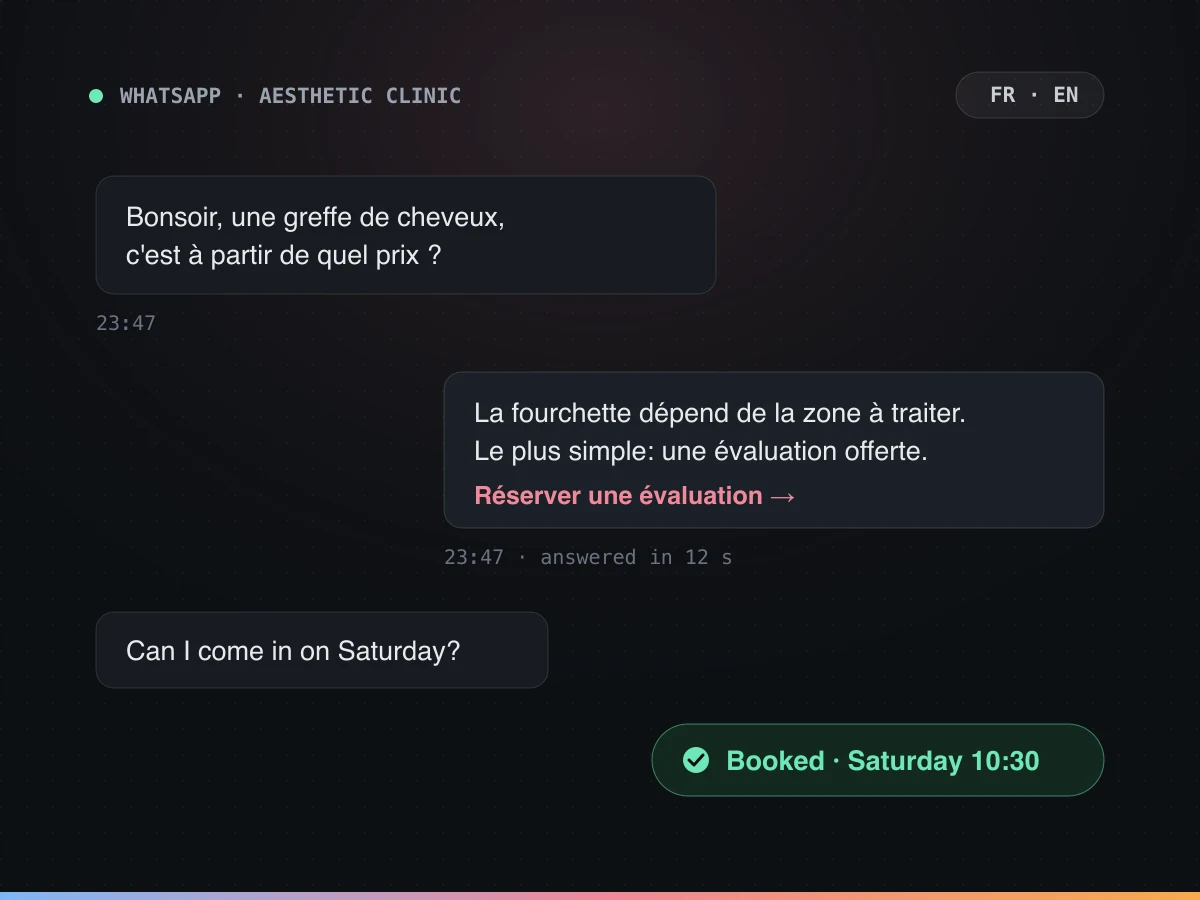
908 of those conversations, 45% of the total, were price inquiries, answered with the clinic’s actual ranges, in French or English depending on who was asking, without anyone at reception touching a keyboard. 91 turned into appointments confirmed inside the chat itself. And 28 conversations, 1.4%, were flagged as sensitive, post-operative pain, complications, real distress, and escalated to a person instead of answered by the agent; on those, zero medical opinions were given, which was the one rule that mattered more than any other in building the thing.
None of that competes with the six platforms above. It sits in front of whichever one you pick, the same way a receptionist used to sit in front of whatever paper chart system a clinic ran twenty years ago, and the same logic holds outside aesthetic medicine too, our breakdown of what an AI receptionist actually does covers the general case if you want it without the clinic framing. If you want the fuller version of what this clinic’s eight months looked like, the full case study has the rest of it, and our aesthetic clinic software page covers what this looks like specialty by specialty, dermatology, hair transplants, injectables, skin treatments, if you’re evaluating it as a purchase rather than just reading about the gap.
What to actually check before you sign anything
A few patterns showed up across all six pricing pages that are worth asking about directly, because none of them are visible until you’re already on the call.
- “Pricing tailored to your practice” means the number depends on how the conversation goes. Four of six vendors here use some version of that phrase. Ask for a number range before the call, not during it; a vendor that can’t give you one hasn’t priced the category, they’re pricing you.
- Asterisks do real work. PatientNow marks telehealth, insurance billing and several add-ons with “availability depends on your practice setup.” Ask which of those are actually live for a practice your size, in your state, before you assume the tier name means the feature works.
- Annual prepay discounts are common and worth asking for anyway. Pabau advertises up to 20% off annual billing; AestheticsPro mentions “savings with annual prepay” without a figure. Neither hides this, but neither leads with it either.
- Data migration and ownership rarely show up on the pricing page at all. Clinicminds’ own FAQ list includes “can I transfer data from my current software provider” and “are there any setup or migration costs,” which tells you it’s a common enough question to warrant a standing answer. Ask it of every vendor, not just the one that thought to publish it.
- Multi-location cost is a different number than the single-location one, and it’s rarely the headline price. AestheticsPro gates it to Executive and above; several others don’t mention it until the quote stage at all.
- “Unlimited patients” doesn’t always mean unlimited photo storage. Before-and-after libraries and video capture get large fast in aesthetics specifically; ask what happens to storage costs once a busy injectables practice has a few thousand patients with multiple photo sets each.
- Contract length is a separate question from monthly price. A $160 tier on a 12-month lock-in and the same number month-to-month are not the same offer, and the pricing page rarely says which one you’re looking at.
Here’s what that actually costs for a concrete example: a two-location practice with five providers total. On AestheticsPro, that’s Executive at $285 a month flat, unlimited users, multi-location included. On Clinicminds, it’s “starting from €160” with the real figure depending on the quote, likely higher once a second location and five practitioners are factored in, since the starting price is explicitly a floor. On the other four, it’s simply unknown until the call, which is the whole point of the transparency ranking above: two vendors let you do this math right now, four don’t.
Onboarding and support, since that’s not on the pricing page either
Every one of the six pricing pages we captured buries a version of the same question in its FAQ accordion rather than its headline copy: what happens after you sign. Clinicminds lists “what kind of support do you offer” and “can I get a free trial” as standing FAQ items, which tells you these get asked often enough to warrant a template answer. MDware’s own pricing page asks itself “are there contracts or setup fees” and “is onboarding and training included,” directly under a banner that otherwise gives no number at all. PatientNow is the most direct about it, closing its pricing page with “no contract, free onboarding and speedy setup” as a stated promise rather than a buried FAQ line.
None of that is comparable across vendors from what’s public, since “speedy” and “free onboarding” mean whatever each company decides they mean until you ask for specifics: how many training sessions, whether your existing patient data gets migrated as part of the fee or billed separately, and how long until a new location is actually live rather than just contracted. Worth writing down as a question for every demo, because it’s the part of the sales process most likely to get glossed over in favor of the feature tour.
Is any of these worth buying without a demo
Probably not, and that’s true even of the two that publish real numbers. What the pricing transparency actually buys you isn’t a purchase decision, it’s a shorter first call: you already know AestheticsPro’s ceiling is $350 and Clinicminds’ floor is €160, so the conversation starts at “does this fit,” not “what does this cost.” The other four make you have that second conversation before the first one; whether that’s a red flag or just how enterprise software gets sold depends on how much time you have to spend finding out.
The honest opinion, since we build software in the adjacent category and have opinions about vendors who won’t put a number on a page: transparency correlates with confidence more often than not. A vendor quoting every deal individually isn’t automatically hiding something, multi-location and compliance-heavy software genuinely does vary by client, but a vendor willing to publish a starting figure and let the rest follow from a real conversation is telling you something about how it sells, which is usually how it operates everywhere else too.
When you do get to a demo with one of the quote-only four, ask to see the thing that’s hardest to fake on the spot: a real patient record, fully charted, through the exact workflow a returning patient would trigger, not a seeded demo account built to look clean. Ask what a support ticket looks like when something breaks on a Saturday, since that’s the day these clinics are often busiest and least staffed to troubleshoot software. And ask the rep directly why the price isn’t on the website, not as a gotcha, but because the answer (compliance review per client, genuine per-location variance, or just a sales process that prefers you not compare) tells you something about the vendor you won’t get from the feature list.
The best aesthetic clinic software for your practice is whichever of these six survives that gauntlet, not whichever one this or any other article puts at number one. Book three demos, not one, and ask the same handful of questions at each: is this an EMR or an add-on to one, what does a second location actually cost, what happens to your patient data if you leave, and, the one nobody on this list will bring up first, who answers the message that comes in the night after your demo call ends. If the answer is “nobody, until morning,” that’s worth pricing too, alongside whichever of the six you pick; our roundup of customer support automation tools is a reasonable place to start comparing that half of the stack.
FAQ
What is the best aesthetic clinic software in 2026?
There isn't one, whatever the title of this article and everyone else's promises. AestheticsPro and Clinicminds publish real prices, so they're the fastest to actually compare. Pabau and PatientNow price by team size behind a demo. Zenoti is built for multi-location groups that also want its AI add-ons. MDware quotes everything custom. None of the six answers a WhatsApp message at 11pm, which turns out to be a separate purchase.
Which EMR system is best for aesthetic nurses or independent injectors?
Outside our six, Aesthetic Nurse Software (ANS) markets itself specifically to solo injectors and cites 2,700+ clinics on its own site. Inside our six, Pabau's Solo tier (one user, unlimited patients) and AestheticsPro's Pro-Plus ($160/month for up to three users) are priced for the same buyer, without the multi-location machinery a nurse working alone doesn't need.
Do aesthetic clinic software platforms include AI?
Yes, mostly on the clinical side, not the patient-facing one. Pabau Scribe drafts charting notes, PatientNow's Catalyst tier adds AI business insights and an AI Scribe add-on, and Zenoti sells a full 'AI Workforce' including an AI Receptionist. That last one is the closest any of the six get to answering a patient, and even it's scoped to phone calls in Zenoti's own listing, not WhatsApp or Instagram.
Is there a free aesthetic clinic software?
Not among the established players. Every platform in this piece gates real pricing behind a demo or, at best, shows a starting number with everything past it unpublished. That's not necessarily a red flag here: a free tier of software holding real patient health data is a compliance question (HIPAA, GDPR) before it's a budget one, and most vendors would rather quote you than cut corners on that.
What's the difference between aesthetic clinic software and the software that answers patients before they book?
The six platforms here run the clinic once a patient is already a record: charting, consent, payments, inventory, reporting. None of them is built to hold a conversation with someone who hasn't booked yet, at 11pm, in French or English, deciding between your clinic and two others. That's a different layer, and it sits in front of whichever EMR you pick, not instead of it.
Do any of these platforms handle WhatsApp or Instagram messages from patients?
Not as a conversation. Several offer SMS marketing or reputation management touching social channels, and Zenoti's suite reaches furthest into automation. But none of the six runs an actual back-and-forth on WhatsApp or Instagram DMs, which is where a lot of aesthetic-clinic inquiries land first. On one clinic we work with, all 2,011 patient conversations over eight months arrived on WhatsApp, not the phone.