AI in BPO: where does the money actually move?
AI in BPO isn't a cost cut. It's three numbers: 100% QA coverage, agents assisted instead of replaced, and a forecast that finally holds up.
Ask a BPO owner what AI changed on their floor and most say “everything,” which usually means they have not measured anything yet. We already wrote the definitional piece on automation in the BPO industry: what it is, what stays human, how to start. This one skips that ground.
It answers a narrower question: where does AI in BPO actually move your numbers? Not “efficiency.” Three places: how much of your floor gets checked for quality, whether an agent is helped or replaced, and whether your forecast is a model or a guess.
AI in BPO changes three numbers a BPO owner actually tracks. Quality assurance can now cover 100% of calls instead of the usual 2 to 5%. Agent-assist tools cut handle time without cutting the agent. Forecasting moves from a spreadsheet’s guesswork to a model tuned on your own call history.
Three places AI in BPO touches your numbers
Every “AI in BPO” listicle runs the same four categories: chatbots, RPA, analytics, “the future.” Call it an AI call center or an AI contact center on your business card. None of those four is a number you can put in a spreadsheet. Here are three that are, and what each one still needs a person for.
| Lever | Old way | With AI in BPO | Still needs a person |
|---|---|---|---|
| Quality assurance | 2 to 5% of calls sampled by hand | 100% of calls scored automatically | Judging the exceptions the rules do not cover |
| Agent cost | Agents search manually mid-call | Real-time assist surfaces the answer | Deciding what to do when there is no policy for it |
| Forecasting | A spreadsheet plus a manager’s gut | A model tuned on the account’s own call history | Reading which agent is about to quit |
We will take the rows in order.
QA on every call: what call center quality monitoring looks like at 100%
Most contact centers run a quality programme and audit almost none of it. The industry number: 2 to 5% of calls get a human reviewer.
A 200-seat floor running 20,000 calls a month means 400 to 1,000 reviews, even when the QA team is generous. The other 95 to 98% happened, and nobody but the customer knows how it went.
Here is the number that should bother you. Three QA analysts, a fair salary of around €30,000 each in most European markets, cost a BPO roughly €90,000 a year to listen to one call in twenty. (Worked example, our own arithmetic, rerun it on your own headcount.)
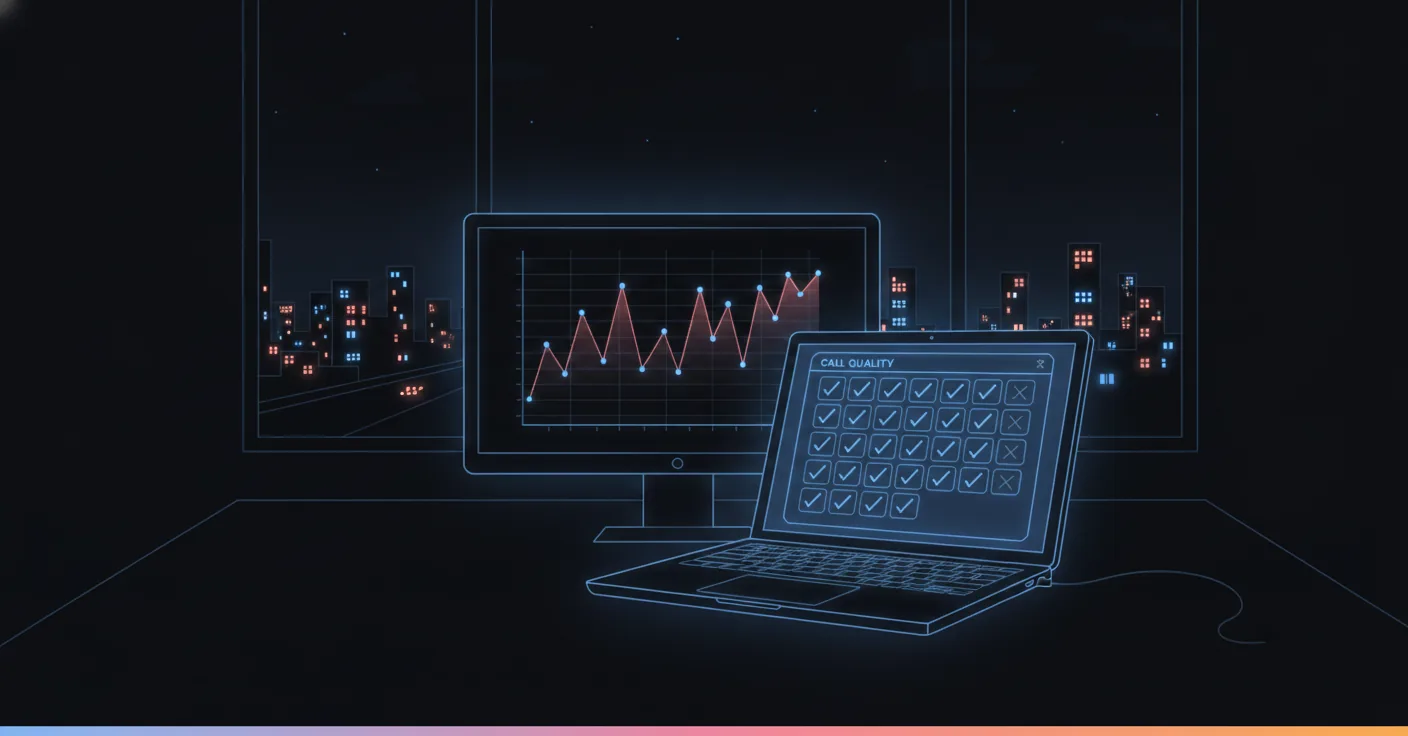
An AI scoring model listens to every call, flags the ones that broke policy, and never gets tired on a Friday afternoon. That is the job speech analytics and automated call scoring were always meant to do, just now at full coverage instead of a Monday-morning sample picked to look good.
The analysts stay. What changes is what lands on their desk: 100% coverage to work from, instead of a small sample they had to choose blind.
This is the same rule as the definitional piece: deterministic beats clever. A scoring model that checks fixed rules against every transcript is not smarter than your best analyst. It is just the first system that shows up for every single call.
Agent assist AI is not agent replacement
This is where most vendor pitches get sloppy, so we will not.
Agent assist puts a suggestion in front of a human who is still on the call: the answer to look up, the next question, the field to fill in. Agent replacement removes the human from calls that do not need one at all. They solve different problems, and a BPO that buys one expecting the other’s savings will be disappointed twice.
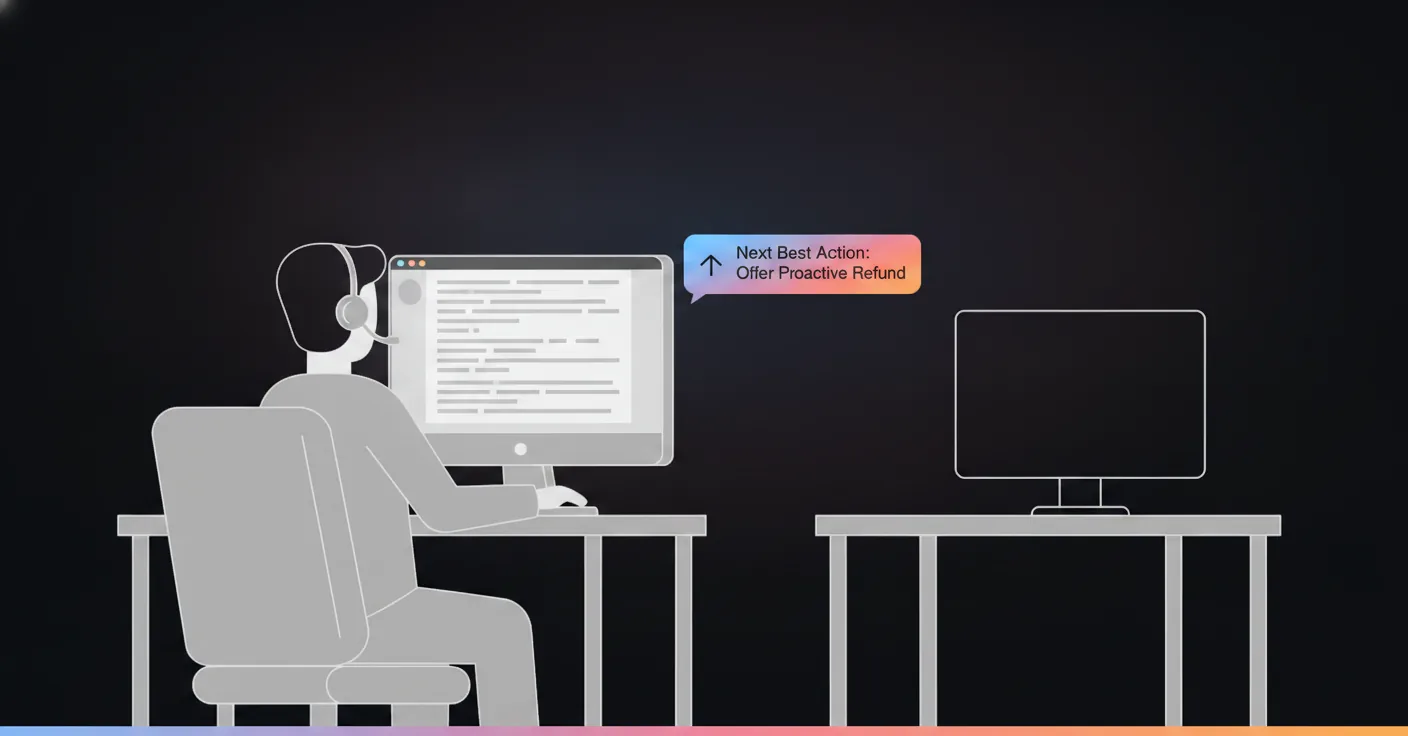
We built an IT-support triage flow for a client last year. Nobody asked for “AI that fixes IT problems.” What they wanted was the ticket pre-diagnosed before a human opened it: the screenshot read, the priority set, the right queue chosen. That is agent assist doing the job people assume needs full replacement, and it is the shape most BPO deployments should actually take.
The numbers back the split. Gartner expects agentic AI to resolve 80% of common customer service issues without a human by 2029, cutting operational costs by 30%. That is the replacement number, and it is three years out.
The assist number is available today. One vendor’s own deployment data puts real-time assist at 30 to 45 seconds saved per interaction, cut from the searching and waiting, not the talking. Take a vendor’s own numbers the way you take a used car’s odometer.
The direction is still right: assist pays now, replacement pays later. A programme that only budgets for one of them will misjudge this year or next.
There is a second reason assist matters on its own. Call center turnover runs 30 to 40% a year. Every departure buys you a ramp period: a new agent, slower and more often wrong than the person they replaced.
Assist tools shorten that ramp, because a new hire searching for the refund policy gets the same prompt a five-year veteran gets.
Forecasting stops being a guess
Ask most operations managers how they build next month’s schedule and the honest answer is a spreadsheet, last year’s numbers, and a manager’s gut. That gut is usually off by a lot.
Manual forecasting error runs around plus or minus 20%, against 5 to 8% once a model is tuned on the account’s own call history. That comes from a workforce-management vendor’s own materials, so treat the exact figure as their sales sheet and the direction as the real takeaway.
Twenty percent sounds abstract until you staff for it. Overstaff by 20% and you paid for idle seats all month. Understaff by 20% and every queue running past its answer-time promise is a client conversation you did not want to have.
Predictive analytics for call center scheduling does not eliminate the swings, spikes still spike. But it narrows the band you are gambling inside, which is most of what the workforce management software category sells, just tuned on your account instead of an industry average.
The other half of forecasting is knowing which calls are worth predicting in the first place. The old call center rule of thumb still holds: roughly 80% of your volume comes from about 20% of your call reasons.
Those repeating categories are exactly what a forecasting model, and an automation build, should target first. The long tail of one-off, odd calls is not where an AI in BPO investment pays back. The repeating 20% is.
What changes on the invoice once call center automation is real
We wrote the full worked example on pricing, hours versus resolved conversations, in the definitional piece already, so we will not repeat the arithmetic here. What is worth adding is that each of the three levers above changes a different line.
QA at 100% coverage does not show up as a cost saving on its own. It shows up as fewer client escalations and fewer contracts you almost lost over an error nobody caught.
Agent assist shows up directly in agent-hours, which is the line most BPO contracts still price by, for now. Forecasting shows up in overtime and idle time, the two costs a tight schedule removes without touching a single call.
On a real estate programme we support, after-hours calls went from unanswered to 100% captured. Half of all calls resolved with no agent at all, and the operator got 5 hours a week back. Those are numbers a spreadsheet forecast would never have found, because nobody was staffing those hours to begin with.
Put the three together and the pitch to a client changes shape. Instead of a discount on the hourly rate, you offer a guaranteed answer time and a quality floor you could not promise before. That is the sentence that gets you an outcome-based line in the contract, instead of another hour-rate negotiation.
What AI in BPO still will not do for you
We are not going to tell you this replaces judgment, because it does not, and any vendor who tells you otherwise is selling you a problem for next quarter.
QA scoring flags what broke a rule. It does not decide whether an angry, borderline case deserves an exception. That is still a person’s call, and it should stay one.
Agent assist speeds up the search for an answer. It does not decide what to do when the answer is not in the policy. Forecasting tells you how many seats to schedule, not which of your best agents is about to quit.
The right comparison for any of this is an employee, not a chatbot. You would not judge a new hire on whether they eliminate the need for management. You would judge them on whether the team gets better with them in it.
Judge AI in BPO tools the same way.
Where to start this month
Pick one number, not all three. If your QA team samples under 5% of calls, start there. Run a scoring model against last month’s recordings before you touch a single live call, and compare its flags to what your analysts already caught.
If your schedule keeps missing by more than a few percent, feed a forecasting model your last twelve months and see where it disagrees with the spreadsheet. Either test runs in a week, on data you already have, before any call center automation software vendor gets a meeting.
Or skip the build entirely: we partner with BPOs to run the QA and assist layer for them. Either way, the two tests above take a week, not a quarter.
FAQ
Will AI replace call center and BPO agents?
Not on the timeline most people assume. Gartner expects agentic AI to resolve 80% of common service issues without a human by 2029, which means the routine share leaves first. The complex, judgment-heavy calls stay with people, and those calls are worth more per hour than the ones AI takes.
What is the difference between agent assist and agent replacement?
Assist puts a suggestion in front of a human who stays on the call, cutting the time spent searching. Replacement removes the human from calls that do not need one. Most BPO programmes should budget for both, since they save money on different lines and on different timelines.
How much of a BPO's calls can AI actually quality-check?
All of them. Manual QA typically samples 2 to 5% of calls, because a human reviewer only has so many hours. An AI scoring model checks fixed rules against every transcript, which does not replace analysts, it gives them full coverage to work from instead of a small sample.
Does AI improve call center forecasting, or just automate the schedule?
Both, but the accuracy gain is the real number. One workforce-management vendor puts manual forecasting error at roughly plus or minus 20%, against 5 to 8% once a model is tuned on the account's own history, which is the difference between guessing and planning.
What is the 80/20 rule in a call center?
Roughly 80% of call volume comes from about 20% of recurring call reasons. It matters for AI in BPO because that repeating 20% is exactly what a forecasting model and an automation build should target first. The long tail of one-off calls rarely pays back the effort.
Does AI in BPO change how a programme should be priced?
It should. Automating the repeating share of a programme cuts cost per conversation, and a BPO that keeps billing by the hour hands that saving straight to the client. Pricing by the resolved conversation instead is what keeps the margin with the operator who built it.