5 Best Bland AI Alternatives 2026: Tested and Ranked
I tested the top Bland AI alternatives in 2026 for pricing, latency, and no-code setup, so you can pick a voice AI platform without the guesswork.
The best Bland AI alternatives in 2026 are:
- WeLoveJoe - Best Overall
- Synthflow
- Retell AI
- Vapi
- Air AI
Most people know Bland AI for its ability to handle tens of thousands calls per hour. It’s a favorite for developers who want deep, granular control over phone systems using “Conversational Pathways.”
However…
…many teams are now looking for Bland AI alternatives mainly because of it being quite technical. Without a visual drag-and-drop builder, you have to code every conversation logic tree from scratch.
High costs also stack up quickly due to hidden fees for failed attempts and SMS. If you need predictable billing or a simpler no-code setup, other tools can now fill those gaps.
I’ve tested the most popular AI call agent tools today to find out the very best in 2026.
Bland AI Alternatives at a Glance
Five platforms, five different bets on what “better than Bland” means. Some chase raw developer control, one chases zero-code speed, one chases the long, expensive sales call. Here’s the short version before the full breakdown.
| Platform | Best for | Setup | Standout strength |
|---|---|---|---|
| WeLoveJoe | Teams that want a natural-sounding agent without an engineering budget | Visual, no-code builder | Keeps context on long calls, syncs straight to your CRM |
| Synthflow | Non-technical managers who want a clean no-code dashboard | Natural-language prompts, visual logic tree | Sub-600ms latency, 200+ integrations |
| Retell AI | Engineering teams building custom logic from the ground up | Raw APIs and SDKs | Bring-your-own-LLM, full API control |
| Vapi | Developers who want a modular stack they can plug into | API plus dashboard, BYOM | Sub-500ms latency, native tool calling |
| Air AI | High-ticket sales teams running long-form calls | Managed setup | “Infinite memory” across 10 to 40-minute calls |
If you only remember one row: WeLoveJoe and Synthflow skip the code, Retell and Vapi hand you the engine and the keys, and Air AI is built for the call that runs long on purpose.
What is Bland AI?
Bland AI is a specialized AI call center platform designed to automate high-volume phone operations using hyper-realistic voice agents. It’s built primarily for developers and enterprises that need to manage thousands of simultaneous AI phone calls without the lag that usually ruins automated conversations.
Bland AI Key Features:
- **AI voice agents:**These digital callers use proprietary models to handle natural, multi-turn conversations. They sound remarkably like a real person because the system allows for human-like interruptions and incredibly low latency.
- **Automated phone calls:**You can program it to trigger calls based on specific events in your CRM.
- **Outbound and inbound calling automation:**Bland AI is flexible enough to manage both cold-calling campaigns and complex incoming support requests.
- **Call center automation use cases:**Many businesses use it to build an AI call center that handles tier-1 support, patient intake, or lead qualification.
Why Look for Bland AI Alternatives?
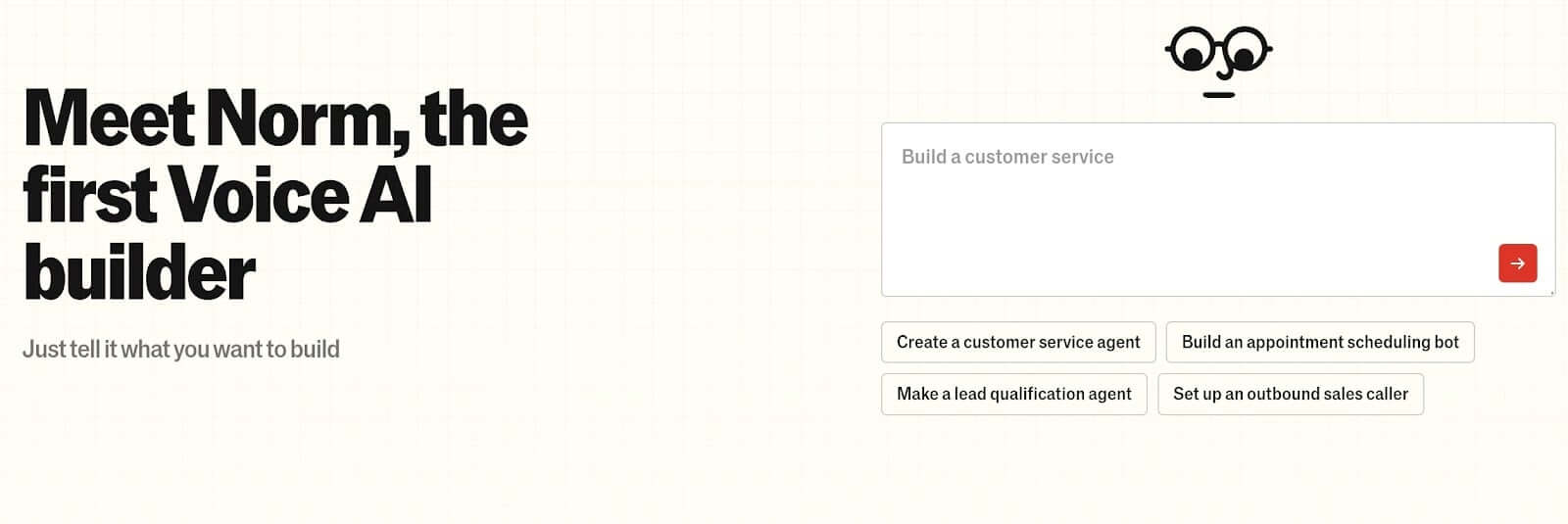
While Bland AI is a powerful choice for high-volume calling, it isn’t the perfect fit for every business. Many users find that the technical barriers and unpredictable costs make it difficult to manage as they grow, leading them to look for a more user-friendly AI voice agent.
Pricing concerns
Budgeting for your AI phone call campaigns can get complicated because of the way Bland AI structures its fees. On top of the monthly subscription, you have to deal with per-minute charges, SMS fees, and even “failed call” penalties for short connections.
For a small business, these hidden costs make it nearly impossible to predict your monthly spend accurately. If pure call volume isn’t your problem and you’re really just trying to stop losing leads to a missed call, our roundup of the best AI answering services covers tools built for that smaller job instead.
Limited customization
If you aren’t a developer, making even a small change to your AI call script can feel like such a chore. The platform lacks a visual drag-and-drop builder, so you have to write or edit code to update your conversation logic.
Integration restrictions
Connecting your phone system to your existing CRM or calendar usually requires custom webhook development rather than a simple one-click setup. Most teams want their AI sales agent to automatically book meetings or update lead status without a complex API project.
Scaling AI call center operations
Managing a large-scale AI call center on Bland AI often leads to stability issues when handling thousands of concurrent lines.
Users have reported that response latency can spike during peak times, which causes awkward pauses that make the bot sound robotic. When your goal is natural phone calling at scale, these small delays can break the trust of your customers and lower your conversion rates. If your calls skew toward after-hours and weekend coverage rather than raw concurrency, a 24/7 AI answering service built for that pattern will get you there faster.
Compliance and spam concerns
Staying on the right side of TCPA regulations and avoiding “Spam Likely” labels is a constant struggle for automated systems. Since this tool is built for high-volume outbound bursts, your numbers can get flagged by carriers quite easily if you don’t have advanced reputation management tools.
5 Best Bland AI Alternatives
Finding the right Bland AI alternatives is usually about trading a developer-heavy setup for a system that actually makes sense for your daily operations. While the big players get the most hype, I found these specific AI voice platforms by testing how they handle real-world calls and CRM syncing.
The best choices focus on specific business goals, like instantly booking appointments, without forcing you to write a single line of code or deal with those hidden “failed call” taxes. (If your callers are asking for a human receptionist first and AI second, our Smith AI alternatives guide is the closer fit.)
1. WeLoveJoe
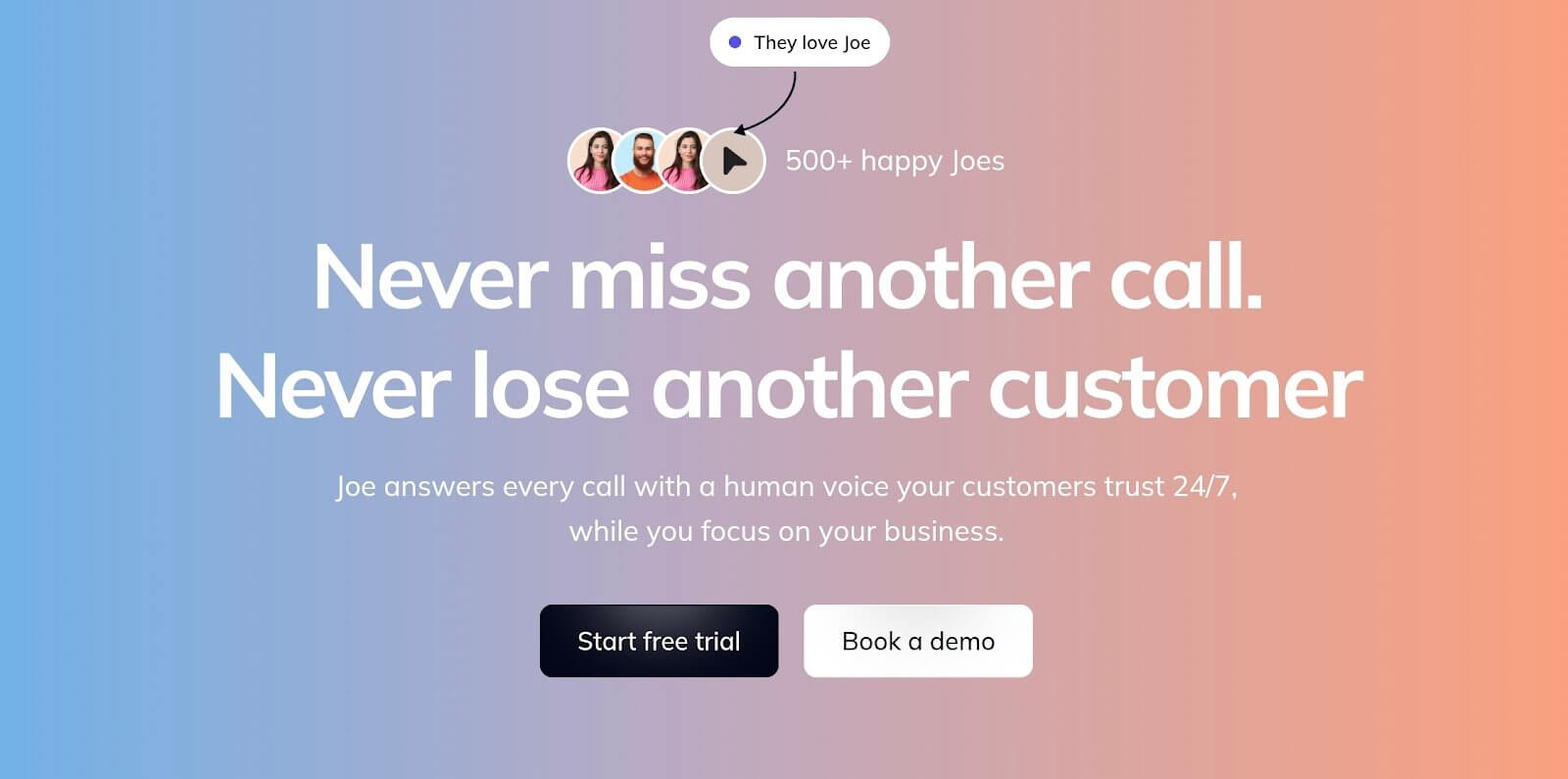
After using the best AI voice tools, I found WeLoveJoe to be the most intuitive choice for teams that need to launch a high-performance AI voice agent without a massive engineering budget. It functions as an all-in-one conversation AI service that handles the job of phone operations.
This makes it much easier to deploy a system that actually sounds natural.
Unlike other tools that feel like a complex coding project, this one excels at maintaining context during long calls to prevent that awkward, robotic looping.
- Outbound and inbound voice agents: These manage your 24/7 phone lines with ultra-low latency. It ensures your customers never deal with frustrating delays or those weird, long pauses that usually scream “I’m a bot” during a conversation.
- **AI cold calling and sales:**WeLoveJoe’s system uses specific logic to handle common objections and follow scripts. It’s a reliable AI sales agent for qualifying leads at the top of your funnel before a human ever needs to jump in.
- **Automated workflows:**You can build complex, branching logic for your calls using a visual editor. This means you won’t have to write code just to change a simple routing rule or update a seasonal greeting.
- **Smart AI call bot:**This feature allows the bot to understand actual intent and emotion. It helps the assistant steer the call toward a real resolution rather than just repeating a static, boring script.
- **Deep CRM integrations:**It acts as a comprehensive AI phone assistant by syncing directly with tools like HubSpot or Salesforce. Every call log and follow-up task gets updated in your records automatically without any manual entry.
Best for:
- **Building AI sales agents:**This works best for sales teams that want to automate their initial AI cold calling and follow-up while keeping a personal, human-sounding touch.
- **Automated workflows:**Small to mid-sized businesses will find this perfect for setting up a sophisticated AI call center that works around the clock without the need for a full-time developer.
2. Synthflow
If the coding requirements of Bland AI feel like a dealbreaker, Synthflow is likely the alternative you’ve been looking for.
I’ve spent quite a bit of time in their dashboard, and it’s easily one of the cleanest “no-code” experiences available today. It’s a top-tier choice for business owners who want sophisticated automation without having to act like a software engineer just to change a call script.
- **AI voice agents and phone assistants:**These bots operate with sub-600ms latency, which is the current gold standard. That speed is vital because it makes a digital voice feel truly responsive.
- Call center automation: It manages lead qualification and support tickets automatically, which really helps a small team feel much larger.
- **AI phone assistant deployment without coding:**You configure everything, from the agent’s personality to its specific objectives, using natural language prompts and a visual logic tree that makes sense to anyone.
- **Workfl****ow automation for phone conversations:**It connects directly with over 200 tools like HubSpot and Zapier. This means your AI call bot can book appointments on your calendar or update a lead’s status in your CRM the second the conversation ends.
**Best for:**No-code AI call agent
3. Retell AI
If your team has the engineering bandwidth to build something from the ground up, Retell AI is a great infrastructure choice.
While other tools focus on user-friendly dashboards, this tool is essentially a high-performance engine for developers, specifically designed for those who want to wrap their own custom logic around a reliable phone network.
- **Developer-focused AI phone agents:**You won’t find a simple drag-and-drop builder here. Instead, the platform provides raw APIs and SDKs that allow your engineers to build a highly customized AI call center agent from scratch.
- **Real-time voice conversations:**Their integrated architecture ensures that your AI call answering feels snappy and natural, avoiding the lag that usually makes callers realize they’re talking to a machine.
- **AI call bot creation:**You have total control over the “brain” of the bot, meaning you can bring your own LLM (like GPT-4 or Claude) and connect it directly to the voice layer.
- API-driven AI calling infrastructure: It functions as a complete conversation AI service for technical teams. You can trigger AI cold calling campaigns or complex inbound workflows directly through your existing codebase without relying on a third-party interface.
**Best for:**Engineering teams building custom system
4. Vapi
If you want the flexibility to build your own stack without starting from absolute zero, Vapi AI could be the middle ground you’re looking for. I found it behaves like a modular engine for AI phone calls, meaning it handles the messy telephony and audio processing while letting you plug in your own choice of “brain” (LLM) and voice.
- **High-performance infrastructure:**With sub-500ms latency in most of my tests, Vapi ensures your AI phone agent responds fast enough to pass for a human, even during complex back-and-forth exchanges.
- **Tool calling and action-oriented agents:**You can build specialized agents that don’t just talk, but actually perform tasks. Since it supports “tool calling,” your assistant can check a database, book a calendar slot, or send a Slack message while still talking to the customer.
- **Automated deployment and phone services:**Moving from a test script to a production-ready system is relatively fast. You can provision numbers through their dashboard or bring your own keys from providers like Twilio to keep your existing “caller ID” reputation intact.
- **Modular voice assistants:**You have the freedom to “Bring Your Own Model” (BYOM). If you have a fine-tuned version of GPT-4 or a custom voice from ElevenLabs, you can plug them directly into the pipeline to create a unique brand experience.
**Best for:**Developers building scalable systems
5. Air AI
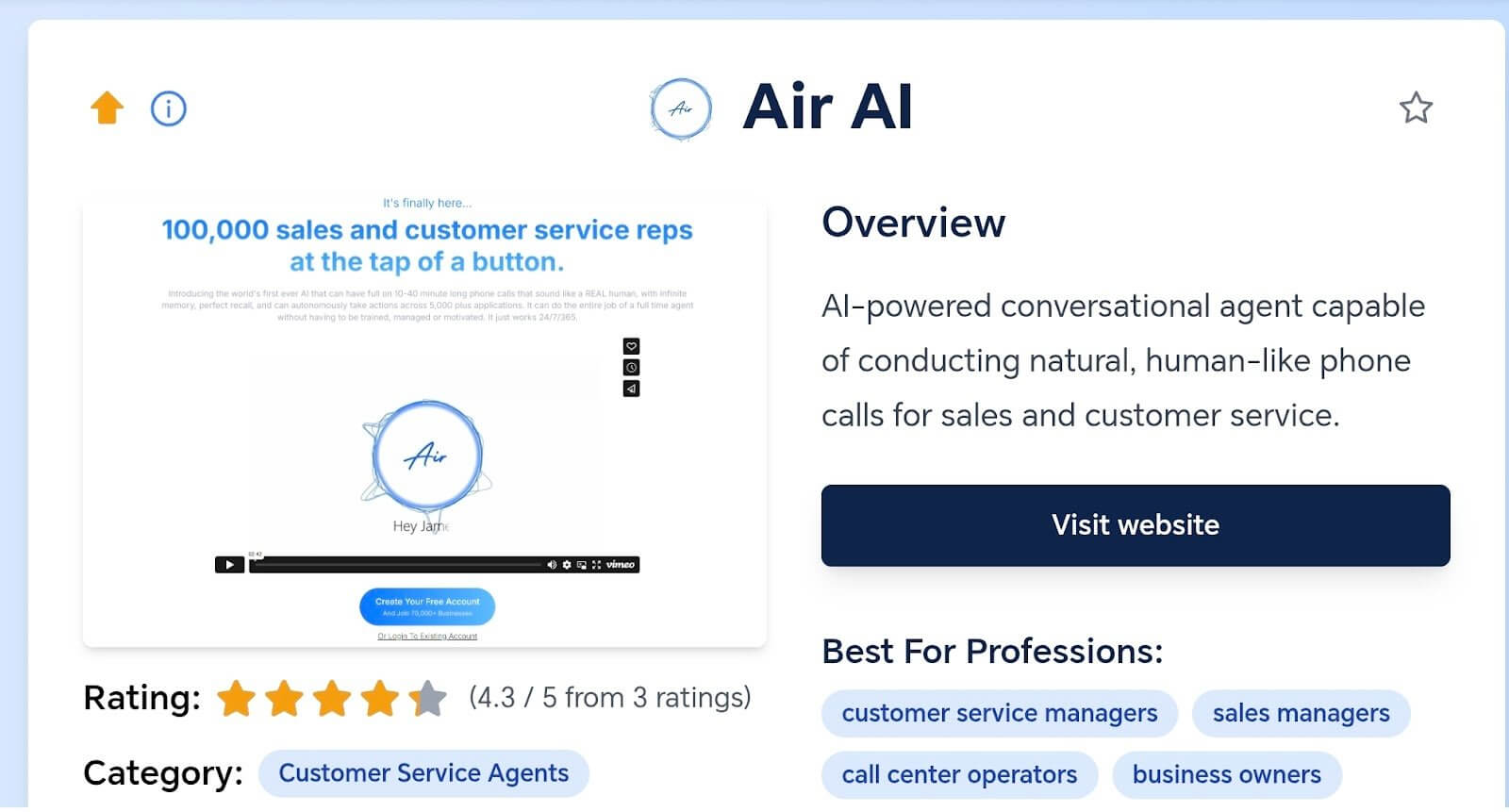
If you have a large-scale sales operation and the budget to match, Air AI is the heavy hitter on this list. Today, Air AI specializes in long-form conversations. Think 10 to 40-minute calls that actually sound like a person is on the other end.
It’s the closest thing to a “set and forget” AI caller for high-ticket sales, provided you can move past the larger upfront licensing fees that Bland.ai usually avoids.
- **Sales-focused conversational logic:**These agents are built specifically for the nuances of selling. They use “infinite memory” to recall what a lead said weeks ago and bring it up naturally during a follow-up.
- Cold calling at scale: You can let the system loose on a list of thousands of leads. It handles the initial outreach, objection handling, and qualification without any human intervention, serving as a high-end AI phone call assistant.
- **Voice realism and tonality:**The tech behind the voice is tailored to mimic natural breathing, pauses, and tonality. This makes it a very effective AI call assistant for brands that are terrified of sounding robotic or clunky during a pitch.
- Full-scale automated calling software: It’s designed to function as a complete AI call center agent, managing both complex inbound support and aggressive outbound campaigns that sync directly with your CRM records.
**Best for:**Sales teams automating outbound calls
Bland AI vs Alternatives: Key Differences
Deciding between these AI voice platforms usually comes down to how much control you want versus how much setup time you actually have. While some options prioritize raw power for developers, others focus on getting your calls live without a single line of code.
Pricing flexibility
Many alternatives skip the “failed call” penalties and high monthly retainers that Bland AI often requires. For instance, WeLoveJoe and Synthflow offer much more transparent, tiered subscription models that make your monthly spend predictable.
Customization and APIs
While Bland is developer-heavy, competitors like Vapi and Retell AI offer significantly more modularity in their actual infrastructure. They allow you to “Bring Your Own Model,” meaning you can swap out specific language models like GPT-4 or Claude depending on your needs.
Even WeLoveJoe provides a more flexible environment for tailoring your bot’s personality without needing to rewrite the entire backend every time you want to make a change.
Voice quality and latency
Some platforms focus heavily on reducing the delay between a human speaking and the AI responding. During my tests, Retell AI and Vapi consistently hit sub-500ms latency, which is the current benchmark for a natural conversation.
Automation workflows
Most modern alternatives include visual drag-and-drop builders that are much easier to use than Bland’s pathway system.
Synthflow allows non-technical managers to build complex call logic without writing code. WeLoveJoe also excels at creating smooth workflows that connect your phone calls directly to appointment scheduling and lead qualification without requiring an engineering degree to set up.
Compliance and call reliability
Advanced platforms have built-in tools to protect your phone numbers from being flagged as “Spam Likely” by major carriers. Air AI and Retell AI provide stronger, enterprise-grade compliance features, including automated number rotation and TCPA guardrails.
How to Choose the Right AI Calling Platform
Picking the right AI phone system depends on your specific goals, because a tool that works for a solo founder won’t necessarily handle a high-volume sales floor. Here are the things you should look out for when choosing the right AI calling platform to invest in.
Voice quality
You need a voice that doesn’t just sound clear, but actually reacts like a person. Today, the standard for a high-end AI voice agent is sub-500ms latency. If there’s a long pause every time the customer speaks, they’ll hang up before the bot even finishes its first sentence.
Look for platforms that allow for interruptions, because a real conversation is never perfectly linear.
Automation capabilities
A great automated calling software should do more than just dial a number. It needs to follow logic, like knowing when to leave a voicemail versus when to push for an appointment. I prefer systems with visual builders because they let you see the entire conversation flow on one screen. This makes it much easier to spot a dead end in your script before you go live.
CRM integrations
***Your calls shouldn’t exist in a vacuum.***The best platforms act as a bridge to your existing data, automatically updating lead statuses or logging call transcripts in HubSpot or Salesforce.
If you have to manually export CSV files at the end of every day, the tool isn’t actually saving you time. Deep, native integration is what separates a basic dialer from a professional AI phone assistant.
Call center scalability
If you plan to scale up, you need to know how the system handles hundreds of concurrent calls. Some AI call center software starts to lag when the volume spikes, which causes those awkward, robotic delays.
You should test a tool’s limits early on to make sure the audio quality stays consistent even when your team is running several campaigns at once.
Compliance and call regulations
Staying legal is the most overlooked but important part of choosing a provider. The FCC ruled in 2024 that AI-generated voices count as artificial under the TCPA, so consent rules apply to AI callers too. You need built-in tools that manage TCPA compliance and prevent your numbers from being flagged as spam by major carriers.
A good tool will offer automated number rotation and reputation monitoring so your calls actually reach the person you’re trying to help.
Pricing structure
Transparency is huge here. You want to avoid platforms that sneak in “connection fees” or charges for calls that never even connected.
I recommend looking for a straightforward pay-as-you-go model or a flat monthly subscription that covers a specific number of minutes. This keeps your overhead predictable and prevents any nasty surprises on your billing statement.
Final Thoughts on Bland AI Alternatives
WeLoveJoe is the standout winner if you want a system that actually works without a massive engineering budget. It handles the heavy lifting of phone operations by offering a much more intuitive interface than Bland, making it easier to deploy an AI voice agent that sounds natural.
While developer-first tools like Vapi or Retell AI offer total API control, they often require a full technical team to manage. For high-ticket sales with a massive budget, Air AI is a heavy hitter for long-form calls.
However, WeLoveJoe balances enterprise power with a simple interface, providing better reliability and lower latency than others I tested.
Your leads would much rather talk to a voice that actually understands them than a lagging robot. Check out WeLoveJoe’s price tiers to see what fits your needs today.
FAQ
What are the best Bland AI alternatives?
I'd personally put WeLoveJoe at the top because it's so much easier to handle than Bland AI while still being powerful. For other specific needs, you've got Synthflow for a no-code approach, Retell AI or Vapi for pure developer control, and Air AI if you're doing high-end sales.
What does Bland AI do?
It's an AI voice agent platform that automates high-volume phone calls using realistic voice agents. Companies use it to handle thousands of calls at once for things like qualifying leads or setting up appointments without needing a human to dial.
What are the most affordable Bland AI alternatives?
WeLoveJoe and Synthflow are the most budget-predictable picks here, both using tiered or credit-based pricing instead of Bland's per-minute-plus-fees model. The real saving isn't a lower sticker price, it's avoiding the failed-call and SMS surcharges that make Bland's actual monthly bill hard to predict.
Which Bland AI alternatives support global calling?
Vapi and Retell AI both let you bring your own telephony provider, commonly Twilio, so you can provision international numbers and keep an existing caller ID reputation. WeLoveJoe and Synthflow handle multi-language conversations out of the box too, but confirm carrier coverage for your specific countries before committing.
Do I need to be a developer to use a Bland AI alternative?
Not anymore, and that's the whole point for most people switching. Synthflow and WeLoveJoe both run on visual, drag-and-drop builders, so a non-technical manager can edit a call script the same afternoon. Retell AI and Vapi stay developer-first if your team wants to write custom logic instead.
Can AI make phone calls automatically?
Yes, it's actually become quite common for platforms to use conversation AI to trigger and manage entire phone calls on their own. These systems are smart enough to have full back-and-forth discussions and then dump all that data directly into your CRM.
What is an AI voice agent?
Think of it as a software program that uses natural language processing to listen, understand, and talk to people over the phone. Unlike the clunky robots from a few years ago, these agents can handle being interrupted and can follow actual conversation logic in real time.
Is AI cold calling legal?
The FCC ruled in 2024 that AI-generated voices count as artificial under the TCPA, so marketing calls generally need prior written consent. Cold calling itself isn't illegal, but the consent and disclosure rules are the same ones that already applied to human telemarketers, just enforced more closely now. Check with a lawyer for your state.