Bilingual Answering Service: What Happens When Your Customers Speak More Than Two Languages?
A bilingual answering service built for English and Spanish breaks the day you cross a border. Here is how to cover every language your customers speak.
It’s 11:20pm in Lyon, and a customer from Montreal just called your Paris clinic. The phone rang out. She will try the next clinic on the list, and the next one will not make her repeat herself in English.
A bilingual answering service fixes exactly that, until your customers speak a third language, or your locations sit in a second country. Most guides assume English and Spanish and stop there. If you work across borders, that assumption is the first thing to break.
A bilingual answering service answers your business calls in two or more languages, around the clock, and then books the appointment, takes a message or hands the call to a person. In the US it usually means English and Spanish. Across borders, the question is how many languages, and whether one set of rules runs them all.
What is a bilingual answering service, really?
It is a front desk that never closes and never says “sorry, I only speak English.”
Two things hide inside that sentence. The first is the pickup: someone or something answers every call, in the caller’s language, within a few rings. The second is the job after the pickup: collecting the name, the reason for the call, a booking, a message, or a transfer. A service that does the first and fumbles the second is a very polite voicemail.
The word “bilingual” also hides a choice. A human service means bilingual receptionists, real people who switch between two languages, usually English and Spanish, working shifts. An AI service means one agent that speaks the languages the vendor trained it on, with no shifts and no rota. Both are called a bilingual answering service in search results, and that is why the SERP is confusing. We will compare them properly below.
If you are new to the category, our guide to AI receptionists for small business covers what the agent does and where it falls short. This post is about the language layer on top.
Why does “bilingual” stop being enough once you cross a border?
Because the second language is a local fact, not a universal one.
Every page that ranks for this keyword in the US treats “bilingual” as a synonym for “English and Spanish.” Fair enough there. NextPhone, an AI answering vendor, analysed 1,446,980 calls across 2,074 of its customers in 2025 and found 8% of calls in Spanish. That is a vendor’s own customer base, not a national survey, but it shows the shape of the demand: a real second language, and then a long tail. The same dataset puts French at 1.7%.
Now move the business. A physio clinic in Brussels takes calls in French and Dutch, and a quarter of its patients ask for English. A property manager in Geneva hears French, German and Italian before lunch. A dental chain in Barcelona serves Spanish, Catalan and the English of every expat who just moved in. Two languages does not describe any of those lines.
Language is also not a courtesy. CSA Research surveyed 8,709 consumers in 29 countries and found that 76% prefer to buy products with information in their own language, and 40% will not buy from websites in other languages. That study is about websites and product pages, not phone calls, so we are not claiming it measures phone behaviour. But nobody has ever found that people tolerate a foreign language better on the phone than on a web page.
A caller who has to switch languages to reach you has already done you a favour. Most of them will not.
The 11pm call in a language nobody on your team speaks
Picture a clinic in Geneva. The team speaks French and German at the desk, and one nurse has decent English. A caller rings at 8:40pm and speaks Portuguese.
A human bilingual service cannot help: it covers English and Spanish, and Portuguese is neither. A voicemail greeting in French invites her to leave a message in a language she can barely follow. The call is gone.
An AI agent that speaks the caller’s language can ask what she needs, check the diary, offer Thursday at 9:15 and confirm it in Portuguese. Then it writes the summary into the inbox in French, the language the team reads. That last part matters more than it looks. The caller is served in hers, the team works in theirs, and nobody translates anything by hand.
That is the whole argument for the AI route in an international context, and it is also where we would tell you to be careful. Every language on a vendor’s list is a claim. Some are excellent. Some are fine for a booking and fall apart on a medical term. You find out by calling, which we get to in the testing section.
Human bilingual receptionists or an AI agent: which one fits your languages?
Pick by coverage first, price second, warmth third.
| Human bilingual service | AI answering service | |
|---|---|---|
| Languages | Usually 2, mostly English and Spanish | Many, vendor-dependent (Joe lists over 20) |
| Hours | Often 24/7, but some languages are staffed fewer hours | 24/7 in every language |
| Pricing | Per minute, per call or monthly, sometimes with a language surcharge | Flat or credit-based, languages usually included |
| Handling a surge | Hold times or overflow | No queue |
| Judgement on odd calls | Good | Only what the flow allows, so you define the handoffs |
| Third or fourth language | Rarely available, or a separate premium line | Check each one by calling it |
Human services have real advantages, and we say so without a wince. Some callers, especially older ones and anyone upset, want a person. A well-trained receptionist reads tone in a way an agent does not. Ruby, for instance, advertises English-Spanish receptionists with bilingual support included at no extra cost, and PATLive runs its Spanish desk from 8am to 10pm Eastern. Notice what that second detail says: the bilingual desk has opening hours. Your Spanish-speaking callers do not.
The AI route wins when you need more than two languages, true 24/7 coverage in each, or the same behaviour across many locations. It loses when your call volume is tiny and a receptionist is already at the desk all day. Take a side: if you have two locations, one language pair and a person at the front desk, you probably do not need this at all.
Our view, plainly: an agent should be judged like a new hire in their first week, not like a chatbot. Can it do the job in the language the customer picked? Does it escalate when it should? Our roundup of the best AI answering services applies that test to the main vendors.
How does a multilingual call actually run?
Language is a layer. The rules underneath stay the same.
Here is the part most bilingual guides skip, because a human service has no “underneath.” A human receptionist carries the rules in their head. An agent needs them written down, and Joe runs on a flow engine: for each type of request (booking, price question, opening hours, complaint), there is a goal, a short list of things to collect and a set of tools the agent may use only at the right moment.
The language sits on top of that. A caller says “bonjour, je voudrais un rendez-vous,” and the agent should answer in French and walk the booking path. A caller says “hola, quiero una cita” and gets the same path in Spanish. The booking logic, the opening hours, the escalation rules and the calendar are one set, not a French copy, a Spanish copy and a German copy that drift apart by March.
Why this matters: translated chatbots and phrase-based phone menus break at the edges. Someone who says “can I move my appointment, I’m sick” in the middle of a Spanish call needs the same cancellation rule as an English caller, applied the same way. When the rules live in one flow, they cannot disagree.
Three things a good setup does in practice:
- Greets once, then adapts. The opening line says the business name and that it is an AI assistant (more on why in the compliance section), then listens to the first answer to settle on a language.
- Keeps the knowledge in one place. Prices, opening hours and policies live in one knowledge base. Add a new language and nobody re-enters them.
- Writes the record in your language. Transcript and summary reach the team in the language they work in, whatever the caller spoke.
If you want the mechanics of how an agent takes a message and books on another channel, how AI agents work on WhatsApp walks through the same flow idea on text.
Does language detection work, or do I need a menu?
Mostly yes, and you should still keep a fallback.
The classic bilingual line says “for English press 1, para español oprima 2.” It works. It also makes every caller do homework before they have said a word, and it falls apart at three languages, because nobody remembers the fourth option by the time the menu reaches it.
The better pattern: a single number, one greeting, and the agent works out the language from the first thing the caller says. Then it stays in that language. If the caller switches mid-call (it happens constantly with bilingual speakers who start in one language and slip into the other for a word they do not know in the first), a good agent follows rather than insisting.
We would still keep one simple fallback: if the agent is unsure after the first exchange, it asks, in the languages you configure, “would you prefer English, Spanish or French?” Asking costs three seconds. Guessing wrong costs the call.
On a bad line, with background noise and a caller speaking a third language, this is also where recognition fails first. Which is a reason to test at a bad moment, not a good one.
What does a bilingual answering service cost?
The honest answer is that it depends on the billing model more than the language.
Traditional services bill in three ways: per minute, per call, or per month for a bundle. Ruby’s cost guide notes that some providers add a Spanish-language surcharge on top, from a few dollars per call to $20 or more a month, while Ruby includes bilingual coverage in its plans. NextPhone’s October 2026 price check puts Ruby at $250 a month for 50 minutes. Prices move, so treat any figure in an article, ours included, as a starting point and check the vendor page.
A rough model of where the money goes:
| Cost line | Human service | AI service |
|---|---|---|
| Base plan | Monthly bundle of minutes or calls | Flat monthly plan or credits |
| Extra language | Sometimes a surcharge, sometimes a separate team | Usually the same plan |
| Overage | Per extra call or minute | Per extra credit |
| After-hours | Often a higher tier | Included in the same plan |
| Setup | Script and call-handling brief | Flow and knowledge base |
Joe starts from €59/month. We will not quote more than that here, because what you pay depends on volume and channels, and the pricing page is the one place we keep current.
One cost nobody lists: the call you do not get. A clinic that misses one new-patient booking a week because the caller spoke the wrong language has a cost far above any plan. We do not have a measured figure for that, and we will not make one up. Your own diary does. Count last month’s unanswered calls, then count how many were in a language you do not cover.
What about franchise networks that span countries?
This is where the AI route gets decisive, and where we have the most to say.
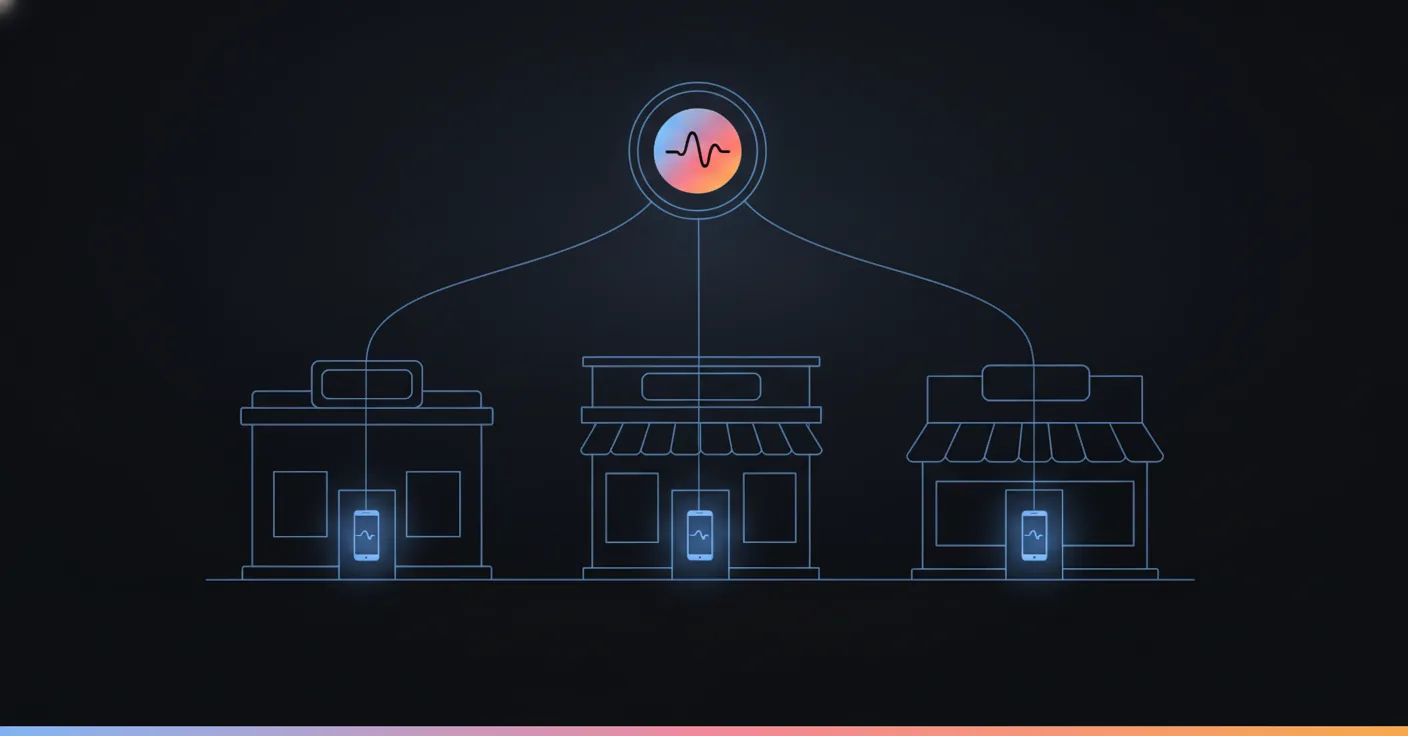
A franchise head office wants every location to answer the same way. A location wants zero extra work. When the network spans France, Belgium and Spain, you add a third demand: each location must answer in its own language, with its own hours, address and manager.
With a human service you would hire a provider per country, or one provider with a team per language, and then keep three scripts aligned. With one flow and per-location variables (hours, address, manager, local numbers), the head office controls the logic once and each location only fills in the local facts. That is the setup we built Joe around, and it is why franchise networks are our ideal customer: the same questions come up at every location, in a different language each time.
The franchise page shows the setup in more detail. Two practical points from that world:
- Local numbers matter. A customer in Antwerp dials a +32 number far more readily than a +33 one. Give each country its own local number pointing at the same agent.
- Time zones are a rota problem for humans and not for agents. A human service needs staff at 3am for your Montreal callers. An agent has no 3am.
Which data rules apply when callers sit in different countries?
The caller’s country usually decides, not yours.
If your callers or your business are in Europe, a call is personal data: the voice, the number, the transcript, and often health or legal details in the conversation. Three questions to put to any vendor before you pick one:
- Where are recordings and transcripts hosted, and who can read them?
- How long are they kept, and can you delete one on request?
- Does the vendor train its own models on your calls?
Joe is hosted in Europe and built for GDPR, with large accounts able to bring their own LLM key, which keeps control of the model with you. That is a buying criterion, not a footnote, and plenty of vendors hand-wave it.
There is also a newer rule. Under Article 50 of the EU AI Act, systems that talk directly to people must make clear that the person is dealing with an AI. Goodwin reports that these transparency duties have applied since 2 August 2026. So the opening line of your agent, in every language you serve, should say what it is. “Hello, this is the assistant of Clinique Saint-Michel” is a gap. “Hello, this is the virtual assistant of Clinique Saint-Michel” is not. US rules differ by state, and we are not lawyers, so check yours.
For healthcare callers in the US, HIPAA enters the picture, and a few vendors in this SERP sign business associate agreements. If that is your world, ask for it in writing.
Where does language stop and culture start?
Formal or informal address is the first place a literal translation embarrasses you.
French has “vous” and “tu.” German has “Sie” and “du.” Spanish has “usted” and “tú.” A clinic wants the formal form with every caller. A skate shop wants the informal one. An agent that picks randomly is wrong half the time, so this needs a setting, per language, per business, not a hope.
Four other things change across borders and trip up a multilingual setup:
- Dates and times. “04/05” is April 5 in Houston and 4 May in Madrid, and “half past eight” becomes “20h30” in France. Read the appointment back in the format the caller uses.
- Numbers and currency. €1.200,00 and €1,200.00 are the same price in different countries. Read it aloud, not as digits.
- Names and addresses. Spelling a Polish surname back to a caller is a better test of an agent than any greeting.
- Industry terms. A veterinary clinic’s “vaccin” or a law firm’s “mandat” must be right. This is the hardest test and the one most vendors skip.
How do you test a bilingual answering service in 15 minutes?
Call it badly, in every language you need, and listen.
Not a clean call from a quiet room with a perfect accent. A real one. Here is the test we would run on any vendor, ours included:
- Call from a noisy place (a car, a street) in your second language.
- Start in one language and switch to another halfway through a sentence.
- Ask a question from your trade with the exact vocabulary a customer uses.
- Change your mind mid-booking. “Actually, make it Friday.”
- Say something it should not answer. A medical question, a threat to sue, a refund demand. Watch whether it hands off, and whether the handoff reaches someone who speaks the language.
- Read the transcript afterwards, in the language your team works in, not the caller’s.
Score each one pass or fail. A vendor who passes five of six in your actual languages is ahead of most. One who will not let you place the test calls, or only offers a recorded demo, has told you what you need to know.
Ask a human service the same questions, particularly about who answers outside the bilingual desk’s hours. And ask for the numbers a good provider will report: answer rate, language mix, handoff rate, and calls abandoned before a booking. A provider that does not track the language mix cannot tell you which language is failing.
Who actually needs this?
A short list, with the honest “no” included.
You probably need it if:
- You take calls in a second language today and sometimes miss them.
- You operate in a country with several official languages (Belgium, Switzerland, Canada, Spain, Luxembourg).
- You run locations in more than one country on a shared brand.
- Your customer base includes tourists, expats or international students.
- You cannot staff the second language at night or on weekends.
You probably do not if you have a single language, one location and a receptionist who is at the desk whenever the phone rings. Spending money on coverage you do not need is the same mistake as the opposite one.
The languages people actually call in are often a surprise, and you only find out by reading transcripts. That alone is a reason to pick a service that gives you them.
How do you set one up without a project?
Start narrow, then widen.
- Write down the requests, not the languages. List the ten things people call about: opening hours, pricing, booking, cancellation, directions, a complaint. That list is the same in every language.
- Pick the languages by what you see. Check the last 30 days of calls and messages. Start with the languages that show up, then add one for each location outside your home market.
- Load the facts once. Hours, prices, policies, the names of people. One knowledge base, not one per language.
- Decide the handoffs. Which topics go to a person, who that person is, and what language they speak. This is the step worth an extra hour.
- Call it yourself with the six tests above, then fix what failed.
- Go live on one number, read the transcripts for a week, and widen from there.
For a single-language business with a night gap, our after-hours answering service guide covers the simpler version of this. For businesses weighing human and AI for the phone line in France, our post on le secrétariat téléphonique externalisé covers the French market.
If you want to hear it first, the agent speaks for itself on the demo page: call it in your second language and listen to what happens. That is a better 10 minutes than reading another comparison.
FAQ
What is a bilingual answering service?
A service that picks up your business calls, and often your messages, and handles them in at least two languages, then books, takes a message or routes to a person. In the US it almost always means English and Spanish. Outside the US, the second language changes by country, and a lot of businesses need a third.
How much does a bilingual answering service cost?
Traditional live services bill per minute, per call or per month, and some add a Spanish surcharge on top, from a few dollars per call to $20 or more a month according to Ruby's own cost guide. AI services usually fold languages into one flat plan. Joe starts from €59/month, with the language question handled inside the plan rather than as an add-on.
Do I need a separate phone number for each language?
No. One number is the better setup, because callers should not have to guess which line is theirs. A good agent greets, works out the language from the caller's first answer and switches. A language menu (press 2 for Spanish) is the fallback for lines with bad audio, not the default.
Can an AI answering service really speak over 20 languages?
Joe lists over 20, but the number on a feature page proves nothing about yours. Test the one or two languages your customers actually use, with the vocabulary of your trade and a heavy accent, before you sign anything. If the vendor will not let you call the agent in that language, that is your answer.
Is a bilingual answering service GDPR compliant?
It depends on the provider, not the category. Calls and transcripts are personal data, so ask where they are hosted, who can read them and how long they are kept. Joe is hosted in Europe and built to be GDPR compliant, and since 2 August 2026 the EU AI Act also expects an AI agent to tell callers it is an AI.
Should a bilingual answering service hand off to a human?
Yes, and in the caller's language. A handoff to someone who does not speak it is worse than no handoff. The rule we use: anything sensitive, such as a medical question, a complaint or a legal threat, routes to a person on a per-business list, and the summary travels with it so the caller never repeats themselves.
What is the difference between a bilingual answering service and a bilingual call center?
Scale and scope. A call center usually runs a larger team handling support, sales and outbound as well as inbound. An answering service covers the front door: answer, qualify, book, take a message. For most small businesses and franchise locations, the front door is the whole problem.
How long does it take to launch one?
With an AI agent the goal is under 15 minutes for the basics, then a day or two of calling it yourself and fixing what it gets wrong. With a human service, expect days of scripting and call-handling setup, plus a trial period to hear how the agents actually sound.